
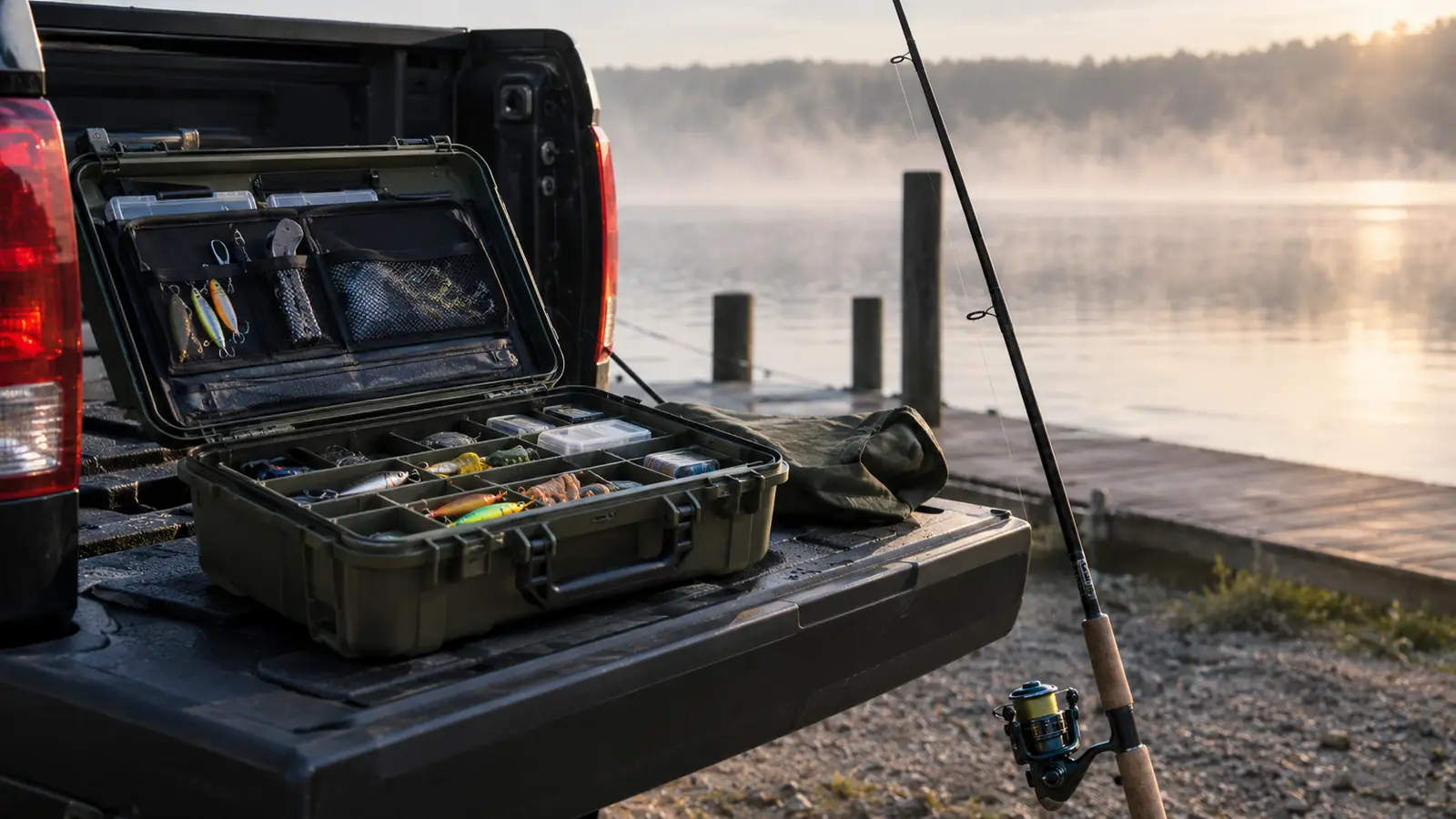
Here is the part of the Plano Angled Tackle System story that usually gets left out of a review: the box did not fix anything by itself. It just made the mess visible. Before March our tackle lived in zip bags in the back of the Tahoe, and loose hooks rolled around on the carpet where nobody could find them until somebody stepped on one. I am the one who plans every trip in this house, so the sorting was going to be my job no matter what I bought. The Plano system at least gave me somewhere to put things while I did it.
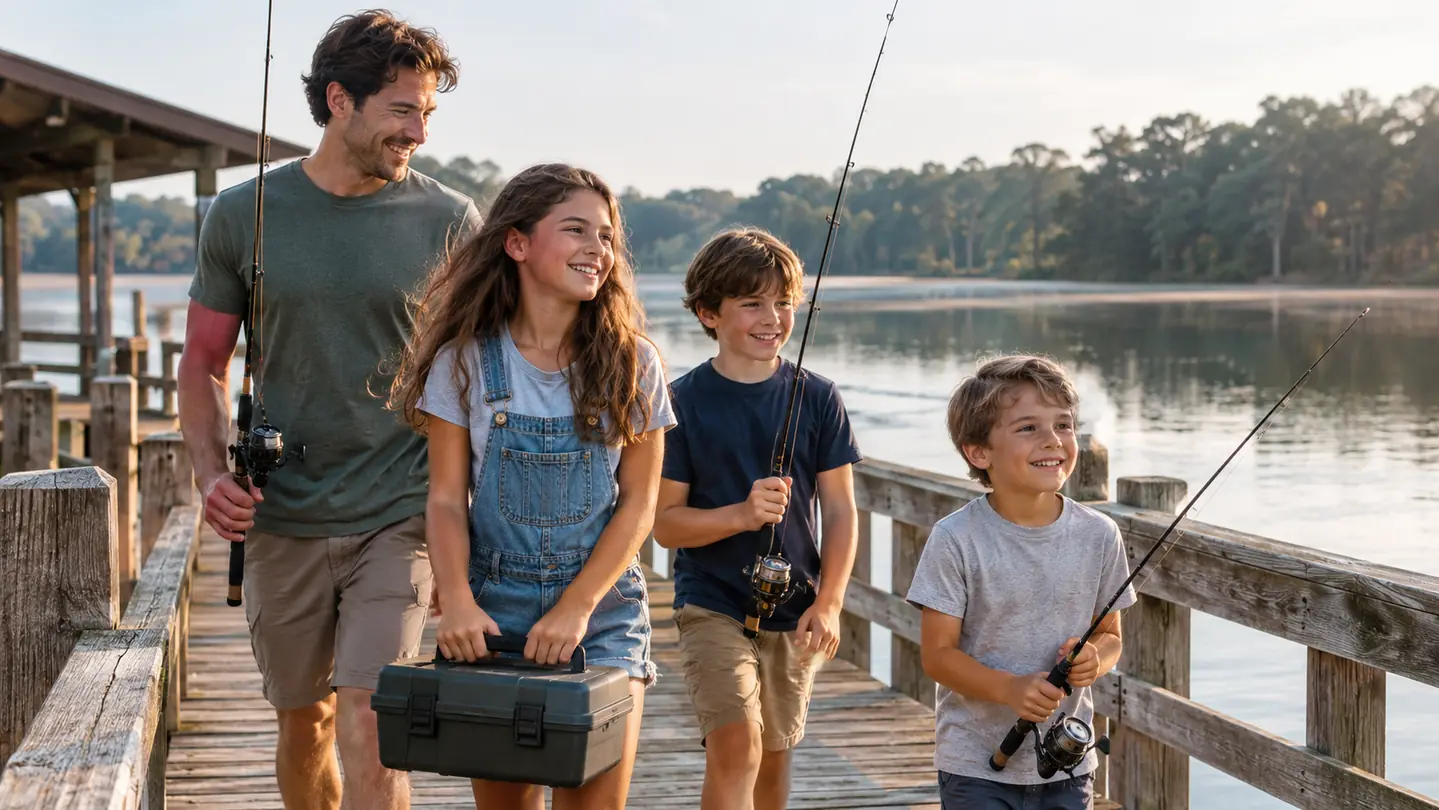
I bought it the first week of March with my own money, along with the rest of the gear I replaced that month, and it has been riding in the back of the Tahoe for about eight months now. Wyatt, who is thirteen, is the one who carries it from the truck to the water. Callie, eleven, rigs jigs out of the second box. Ben, nine, is a bobber and worm kid and mostly stays out of the case. That split is worth knowing up front, because it explains most of what I am about to tell you, the good parts and the annoying ones.
The Quick Verdict
The angled compartment lets me see into all three boxes without unpacking a thing, and the hard case has survived eight months of kids and truck floors. It is also bulky, 5.7 pounds before much goes in it, and more than my nine year old wants to haul.
Amazon Check Today's Price →Three boxes in one case, and nobody digs for a split shot again
The angled compartment holds three Stowaway boxes with their tops facing you, so the hook you need is already in sight. It is the setup that ended the zip bag era in my truck.
Amazon Check Today's Price on Amazon →How I Have Actually Used It
The system lives in the back of the Tahoe and comes out on Saturday mornings, plus weekday evenings once school let out. On pier days Wyatt hauls it from the parking lot. On pond days it sits on the tailgate while everybody rigs up and stays open the whole time. I have never carried it any real distance, and I want to be honest about that, because a lighter box would not change my life much. It would change Wyatt's. The longest walk we do is from the far lot at the reservoir down to the second pier, and I paced that one Saturday in April out of curiosity: about a hundred and forty yards. Wyatt made it without complaint. He also set the case down twice on the way and picked it back up without being asked, which tells you something about the weight.
The sorting is by job, not by kid, and that was the decision that made this thing work for us. Box one is bluegill: small hooks, bobbers, split shot. Box two is crappie and holds the Crappie Magnet kit. Box three is catfish: bigger hooks and sinkers. When Ben says he wants to fish for bluegill, we open one box and everything he needs is already in it. Nobody digs through a shared bag looking for a hook that got moved. The other thing the Plano does that a bag never did is let a single box leave the case on its own. If Callie wants to carry the crappie box over to the rail while the case stays on the bench, she can, and everything else is still sorted where she left it when she comes back.
That sounds small written out on a page. It is not small at the water. The old way, we lost ten minutes at the start of every trip to sorting and untangling, and Ben loses interest in about four.
Before this, our whole system was a gallon zip bag per trip, and that bag got heavier and more tangled every week until I finally dumped it out on the tailgate and quit. The first trip with the case was a Saturday in mid March at the pier, and Ben caught a bluegill on his first good cast. I do not think that had anything to do with the tackle case. It had to do with the fact that we were not spending the opening ten minutes untangling somebody's line or hunting for a hook, so he got a worm in the water while he still wanted to be there.
What Nobody Tells You About the Angled Design
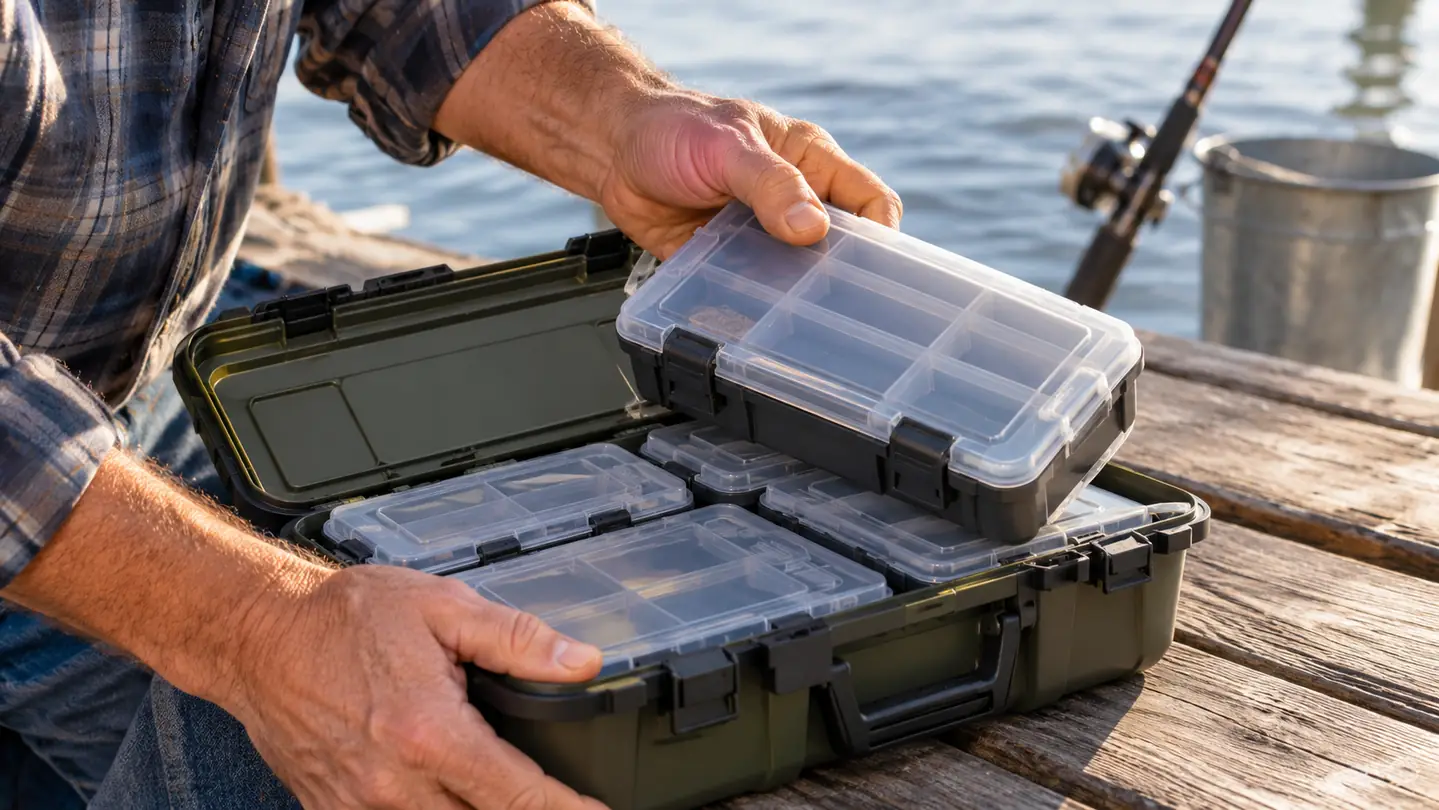
The main compartment holds the three Stowaway boxes at a fifteen degree angle. That is the whole idea behind the case, and to its credit it does what it says. When the lid is open the tops of the boxes face you instead of lying flat, so you look down and see into all three at once. I can tell which box is running low without lifting a single one out.
The clear DuraView covers are the other half of that trick, and I do not think people give them enough credit. Because the covers are see through, the angle actually shows you something. If they were solid you would be looking down at three slanted rectangles and guessing. Because they are clear, you are looking at hooks and sinkers and bobbers, and your brain reads it in about a second.
Now here is the part nobody says out loud. The angle is a reading feature, not a working feature. It helps you find things and it does nothing at all to help you get them out. Every hook still comes out through a lid, and the case still has to be open and in front of you on something flat. On the soft bank at my aunt's pond, where the ground is uneven and the truck is twenty yards up the hill, I still end up holding a box in one hand while Ben picks through it. The fifteen degrees does not help with that part.
The Weight Is the Part People Skip Over
The listed weight is 5.7 pounds, and that is the empty case with the three boxes inside it. Load it the way we load it, with hooks and sinkers and a few small plastics, and it climbs fast. Sinkers are the killer. A handful of catfish weights does more to the number on the scale than every hook in the case combined, and every one of those weights lives in box three.
For me, at forty one and already hauling a folding chair and a bucket besides, 5.7 pounds is nothing. For Ben at nine it is a real load, which is exactly why he does not carry it. Wyatt is thirteen and physically able, and even he has started to comment on the walk from the far lot down to the water. I put the loaded case on the bathroom scale one evening in June, mostly to settle an argument. With all three boxes stocked and the utility pocket full of clippers and spare bobber stops, it came in right around nine pounds. Nine pounds in one hand with nothing to sling it over is the number that matters, not the 5.7 on the listing.
There are no wheels on this case. I say that plainly because I have seen people assume otherwise and then get surprised. It is a carry it or leave it in the truck kind of box. If your fishing involves a long walk along a shoreline, this is the wrong shape of storage for you, and no amount of clever angling changes that.
Eight Months on the Floor of a Tahoe
Ours has been dropped, sat on, rained on at the pond, and used as a step by a nine year old who could not reach the tailgate. The hard shell has a few scuffs and I have not found a crack anywhere on it. The clear covers are not as clean as they were in March, but I can still see through them, and a wipe with my thumb takes care of most of it. The drop that worried me was in May, when Wyatt set it on the tailgate and it slid off onto gravel while he was reaching for a rod. It landed on a corner. The corner is scuffed white and the case still closes flush.
The three boxes still seat in the compartment the way they did on the first day. Nothing has popped loose on the drive home, which honestly surprised me given what the back of that truck looks like after a Saturday.
I have not had to replace a box and I have not lost the case. That sounds like a low bar to clear. With three kids and a vehicle that doubles as a gear shed, it is the bar I use.
What I cannot tell you yet is how it handles a hard freeze. We bought it in March, so this will be the first cold season it spends overnight in the Tahoe. I am not going to pretend I know how the plastic behaves at twenty degrees, because I do not.
What I Liked
- Three Stowaway boxes sit at a fifteen degree angle, so you can see into all three without unpacking anything
- Clear DuraView covers mean the angled design actually shows you the contents instead of hiding them
- The hard shell has survived eight months of kids, truck floors and one rain shower without a crack
- Sorting one box per species ended the ten minute dig at the start of every trip
- The utility pocket keeps the odds and ends out of the hook boxes
Where It Falls Short
- 5.7 pounds before you put anything in it, and sinkers add up fast
- Bulky at 18 by 9.5 by 11 inches, it takes real room in the back of a truck
- No wheels, so it is a carry it or leave it in the truck case
- Heavier than a nine year old wants to haul any real distance
The angle helps you find things. It does nothing to help you get them out. Every hook still comes out through a lid.
Two Things I Would Change
First, I would want a shoulder strap on it, and I would pay extra for that. I know a hard case is not a bag and I know the whole point is that it is not a bag. But 5.7 pounds with no way to sling it over one shoulder is a box you carry in front of you with both hands, and that gets old on the walk from the far lot.
Second, I would shave an inch off the footprint. It fits fine in the cargo area of the Tahoe, but it does not fit the floorboard behind the second row and it does not fit the shallow well I was sure it would. So it rides loose, and loose means it slides when I turn out of the parking lot.
That is a short list, and it is short because the design holds up. Eight months, three kids, one case, and the only thing I actively want changed is how it carries. Most of the gear I buy for this family does not last long enough for me to have opinions about the details. The rod kit I bought the same month has already had a reel taken apart and put back together on the kitchen table. The Plano has needed nothing but a wipe.
What Goes in Each of the Three Boxes
Box one is bluegill. Small hooks, a couple of bobbers, split shot. This is Ben's box, it is the one that gets opened the most, and it is the one that gets refilled the most. Small hooks are easy to lose and cheap to restock, which is a good reason to keep them away from everything with a bigger hook.
Box two is crappie. The Crappie Magnet kit lives here, all 115 pieces of it, and this box stays shut unless we are on the pier on a weeknight in spring or fall. Callie rigs those jigs. She is eleven and her fingers are better than mine for the tiny pieces, though she still loses some.
Box three is catfish. Bigger hooks, sinkers, the heavy end of the operation. This is the box that makes the case weigh what it weighs. It is also the box that would be a genuine problem loose in a gallon bag, because a big hook in a bag will find your hand eventually.
The utility pocket takes the odds and ends that do not earn a box of their own. Line clippers, spare bobber stops, a pack of something I bought once and never used. Having that pocket means those things are not rolling around the cargo area anymore, which was half of the original problem.
Who This Is For
This is for the person whose tackle currently lives in bags, in a drawer, or in a boat compartment where the hooks can find each other. If you fish more than one species and you fish from a bank, a pier, or a dock with the truck parked close, the Plano earns its keep. You will see what you have, you will stop buying a third pack of split shot because you could not find the first two, and the hard shell will take a beating without complaining.
It is also for a family, which surprised me. Three boxes, three jobs, and a kid can be told to go get the bluegill box and actually come back with the bluegill box. That does not sound like much. If you have watched a nine year old hand you the wrong bag of hooks four times in one afternoon, it is a lot.
One more thing I would tell a friend. Sort it before the season starts, not in a parking lot. I did ours on the kitchen table on a weeknight in March with all three kids handing me things, and that sorting is what made the case useful. Load it in a hurry with everybody talking at once and you will end up guessing which box holds what.
Who Should Skip It
Skip it if you walk to your spots. This case is 18 inches long, 9.5 wide and 11 tall and it has no wheels. On a long shoreline walk or a hike back to a farm pond, a soft bag over your shoulder beats this on every count. I have never owned a soft tackle bag, so I am not going to pretend to review one. I can see what the regulars at the pier carry, and I can see why.
Skip it if you carry one small box and nothing else. Somebody with six lures and a pack of hooks does not need three boxes and a hard shell with an angled compartment. That person needs a pocket.
And skip it if a child under about ten is going to be the one hauling it down to the water. Ben cannot manage it and I would not ask him to. Wyatt can, and Wyatt is thirteen and strong for his age, but even he notices the weight on a long walk.
If your tackle still lives in zip bags, this is the fix that held up for eight months
Three boxes, sorted by job, angled so you can see them without unpacking. It is not light and it is not small, but it has not cracked, popped open, or cost us a single trip.
Amazon See the Plano Angled Tackle System on Amazon →