
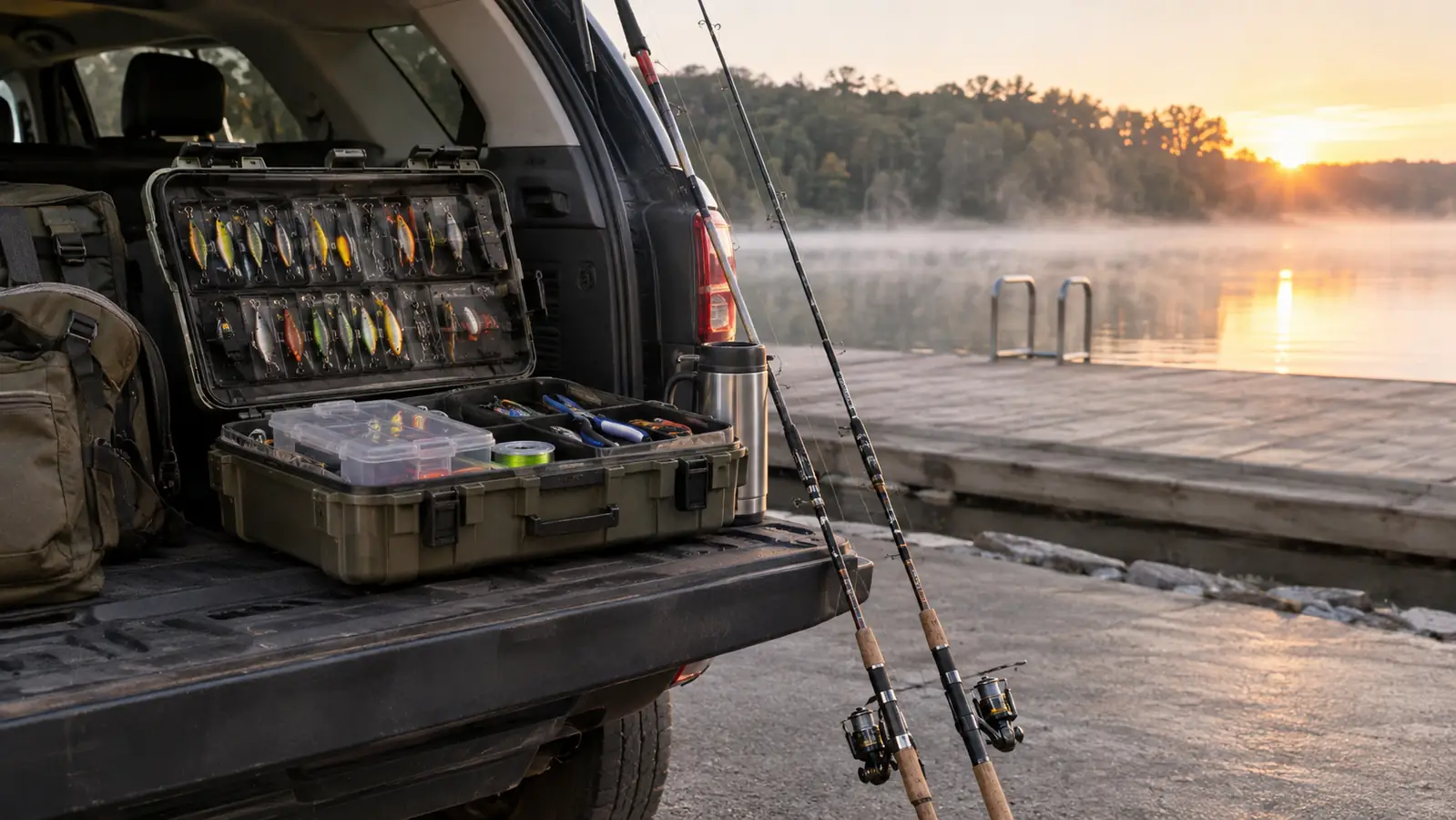
The loose hooks rolling around the back of my Chevy Tahoe were what finally did it. We had come off a cold Saturday at the pier in late February, one hour in, because the line on our old discount combos kept coming off the spools in bird nests and Ben was crying in the wind. When I unpacked that afternoon, a size 6 hook was stuck in the carpet and two more had worked their way under the third row. I ordered the Plano Angled Tackle System the first week of March along with the rest of what we needed, and I paid for it with my own money. I have used it twice a week, give or take, ever since.
I am not a guide and I do not play one on the internet. I am a school office clerk in Brandon, Mississippi, and I fish the bank and the public piers around Ross Barnett with Wyatt, Callie and Ben. My grandfather taught me on a farm pond when I was small, so most of what I know came from an old man, a cane pole and a lot of patience. The whole point of our Saturdays is that nobody melts down before lunch. Eight months in, the Plano box is the piece of gear I think about least, and that is the highest thing I can say about tackle storage.
The Quick Verdict
Three boxes, a 15 degree angle that lets you see what you own, and a hard shell that has survived eight months in the back of a Tahoe. Heavy and bulky for a nine year old.
Amazon Check Today's Price →What replaced our zip bags and the coffee can
Three Stowaway boxes held at an angle inside a hard case, so the compartments face you when the lid opens. This is what has ridden in the back of our Tahoe since the first week of March.
Amazon Check Today's Price on Amazon →How I've Used It
The case lives in the back of the Tahoe from March through November and comes out on every single trip. Wyatt is thirteen and he carries it, mostly because he claimed the job before his sister could. It sits flat on the tailgate while we rig up, and it goes back in the truck closed. We do not baby it. It has been rained on, sat in full sun for four hours in June, and been stepped over by a nine year old at least a dozen times. None of that has cost me a thing.
A normal Saturday starts with me up at six and the kids in the truck by seven. We get to the pier, Wyatt sets the case on the tailgate, and each kid goes to their own section without asking me where anything is. That sounds like a small thing until you remember what we replaced. The old system was three zip bags, a coffee can of sinkers and me digging through all of it in the half dark while the sun came up over the water.
We also fish my aunt's farm pond on weekday evenings once school is out. That is a catfish setup with the rods in ground holders, and the case handles it the same way it handles the pier. The difference is that pond trips run lighter. I pull out one box, leave the rest in the truck, and we walk down to the water with two rods and a bucket.
One note on where we fish: the ground holders stay in the Tahoe on pier days, because a stake cannot do anything on wooden decking. The tackle case comes with us every time, pier or bank. It is the only piece of the setup that never gets left behind.
What the Angled Design Actually Does
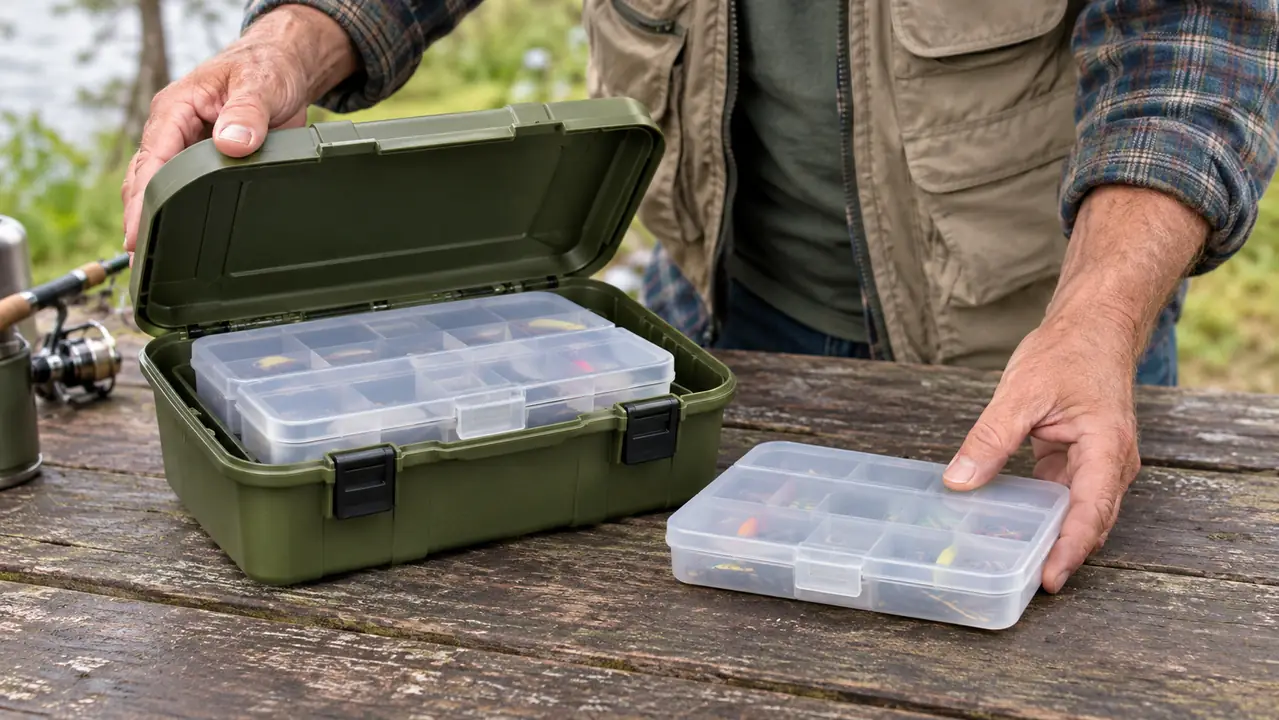
The main compartment holds the boxes at a 15 degree angle. In practice, that means when you open the lid, the boxes face you instead of lying flat. You read the compartments from above without lifting anything out. On a pier at seven in the morning, with two kids asking where the bobbers went, that angle is worth more to me than every other feature on the case combined.
The covers and doors are clear, what Plano calls DuraView. Callie can look down through a cover and see whether the small hooks are where she left them without dumping a tray into her hand. If you have ever watched an eleven year old try to find one split shot in a full compartment, you understand exactly why that matters.
The boxes also lift out. That sounds obvious until you have used a box where they do not. If we are chasing crappie for the evening, box two comes to the rail with us and the case stays shut on the tailgate. I am not carrying three trays of terminal tackle I will not touch.
What Actually Fits in the Three Boxes
Box one is bluegill, and it is the one Ben uses most. Number 8 and number 6 hooks, a handful of clip on bobbers, split shot, and a couple of small jig heads. It is not full. That is on purpose, because a full compartment is a compartment a nine year old empties onto the dock.
Box two is crappie. That is where the Crappie Magnet kit lives, along with the jig heads that go with it. Callie rigs from that box on weeknights in spring and fall, and it is the box that gets opened the most in April. She has her own way of laying it out and she does not want me rearranging it.
Box three is catfish, and it is the heaviest of the three. Bigger hooks, egg sinkers, a few swivels. The compartments in this box are the ones I fight with, because a pack of large hooks does not sit neatly in a slot meant for terminal tackle. It works. It just works the way a suitcase works when you pack one size too much.
How It Has Held Up Since March
Eight months of twice a week use, and nothing on the case has cracked or come apart. The lid still sits flat. The boxes still slide in and out at that angle without catching on anything. The only marks on it are scuffs on the outside from riding against the cooler and the rod bag, and those are cosmetic. I have not replaced a single piece of it, and I have not needed to.
The hard shell is the reason I bought it. Our previous setup had no box at all, only zip bags, and a zip bag in the back of a Tahoe gets crushed under a life jacket and splits at the corner. This one has been under a tackle bag, a five gallon bucket and a wet towel and it has not cared. The material is listed as a blend rather than a single plastic, and it has held up to being stacked under everything else we haul.
What does show wear is the inside of the small compartments, where the dividers have collected grit and a little rust dust off old hooks. I rinse the boxes out a couple of times a season and let them dry open on the porch. Do not put the case away wet with the lid shut. That is not a design flaw. That is what happens to anything you close up with pond water still in it.
Living With the Size and the Weight
It measures 18 inches long, 9.5 inches wide and 11 inches tall, and it weighs 5.7 pounds loaded light. That is a real footprint in a vehicle. It fills the gap between the cooler and the wheel well and there is not much left over. In a truck with a full back end it is nothing. In a sedan trunk with groceries, you will notice it.
There are no wheels on it and it is not a shoulder bag. If you park within a hundred yards of where you fish, this is a non issue. If you walk half a mile in to a bank spot, you will feel 5.7 pounds by the time you get there, especially with rods and a bucket in your other hand. Ben is nine and he can lift it across a parking lot and no further, which is why Wyatt carries it.
Sorting by Job, Not by Kid
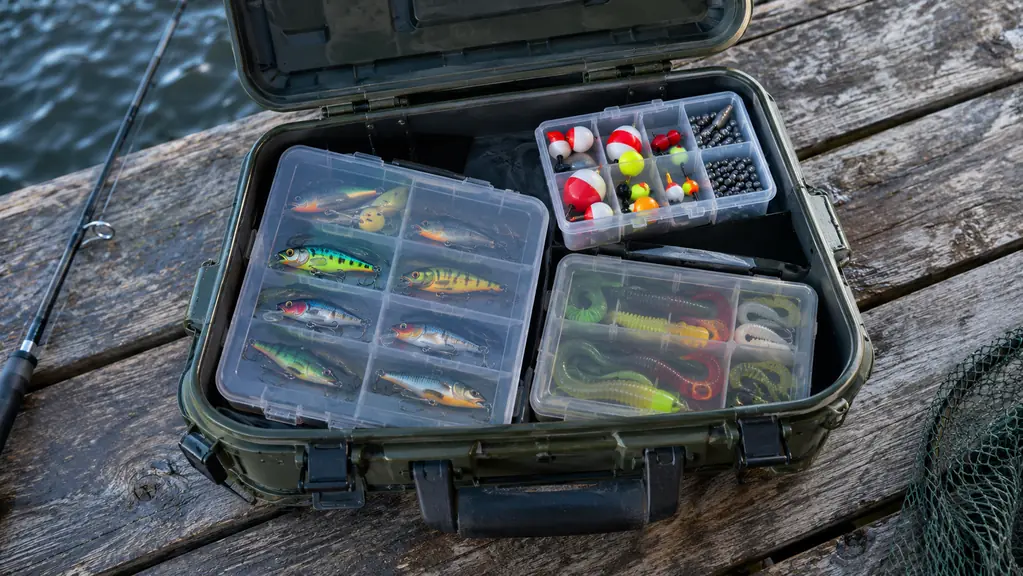
Sorting by species instead of by child is the thing that made this work for us. Nobody has to own a whole box to fish one setup. Ben goes to box one, Callie goes to box two, and when we set catfish rods out, box three comes out of the case and travels to the rod holders. On a good evening all three boxes are open along the tailgate and nobody is asking me for anything.
The payoff came on a weeknight in April at the public pier. Callie rigged jigs out of box two, Ben fished a bobber and a worm, and we came home with about a dozen crappie for supper. That is our best night of the year and I am not going to pretend it was all the tackle box. But nothing about that evening required me to dig, and I never had to stop rigging a kid to go find a hook.
It also forced a discipline I did not have before. Everything has to fit in one of the three boxes or it stays home. That rule has saved me money. I stopped buying a package of something because it was on sale with no plan for where it would live, which is exactly how I ended up with a coffee can of sinkers in the first place.
The Soft Bag Question
I have never owned a soft tackle bag, so I am not going to tell you this beats one. What I can tell you is what I see at the pier. The regulars who carry soft bags have them slung over a shoulder with both hands free, and they walk in from the far parking lot without thinking about it. That is a real advantage and I would not trade it away if my walk were long.
What I wanted was a box that would sit flat and stay shut with three kids around it, and a soft bag does not do that in my experience of watching other people's bags tip over on a dock. If you fish close to the truck and you want compartments you can see into, the hard case is the better shape for the job. If you walk in, the bag probably is.
What I Would Change
I would make a smaller version of the same case for Ben. At 5.7 pounds loaded light he can manage it across a parking lot and no further, and he is not going to grow into it before next spring. Plano makes other sizes, and if I were buying again for a nine year old I would look at one of those first and keep this one for Wyatt.
I would also want the dividers to be a little more forgiving on the catfish box. Everything else in the case is sized right. That one box is the one I fight with, and it is a small complaint in eight months of otherwise not thinking about my tackle storage at all.
What I Liked
- Three separate boxes sort by species, so a kid can rig without digging
- The 15 degree angle lets you read a compartment without lifting the box out
- Clear covers mean you see what you have before you open anything
- Hard shell has taken eight months in a truck without cracking or splitting
- Boxes lift out, so a short evening trip travels light
Where It Falls Short
- 5.7 pounds loaded light and 18 inches long, heavy for a nine year old
- No wheels and no shoulder carry, so it is a two hand job on a long walk
- Small compartments fight with a pack of large catfish hooks
- Takes up real cargo space in a small vehicle
Nothing has cracked, nothing has come open on the drive, and I have not fished a hook out of the Tahoe carpet since March.
Who This Is For
This is for the parent who fishes the bank or a public pier with kids and is tired of a bag full of loose hardware. It is for the family that sorts by species, or wants to start, and needs a box that survives being thrown in the back of a truck. It is also for the angler who keeps everything in one place and wants to see it without unpacking it onto a tailgate.
If your trips are close to the truck and your kids are old enough to carry something, this will solve a problem you may have stopped noticing. Our hooks live in it now. That is the whole review.
Who Should Skip It
Skip it if you walk in. A hard case that weighs 5.7 pounds with no wheels is the wrong shape for a long hike to a bank spot or a kayak launch. Skip it if you drive something small, because 18 by 9.5 by 11 takes up more cargo room than people expect when they order it.
Skip it if you want one bag you can sling over a shoulder and forget about. This is a box. It behaves like a box, it takes two hands on a long walk, and it is not going to pretend otherwise.
If your hooks are living in the truck carpet, start here
One hard case, three Stowaway boxes, and a lid that holds them at an angle so you can see what you have without unpacking it. Eight months in ours and nothing has broken yet.
Amazon Check Today's Price on Amazon →