
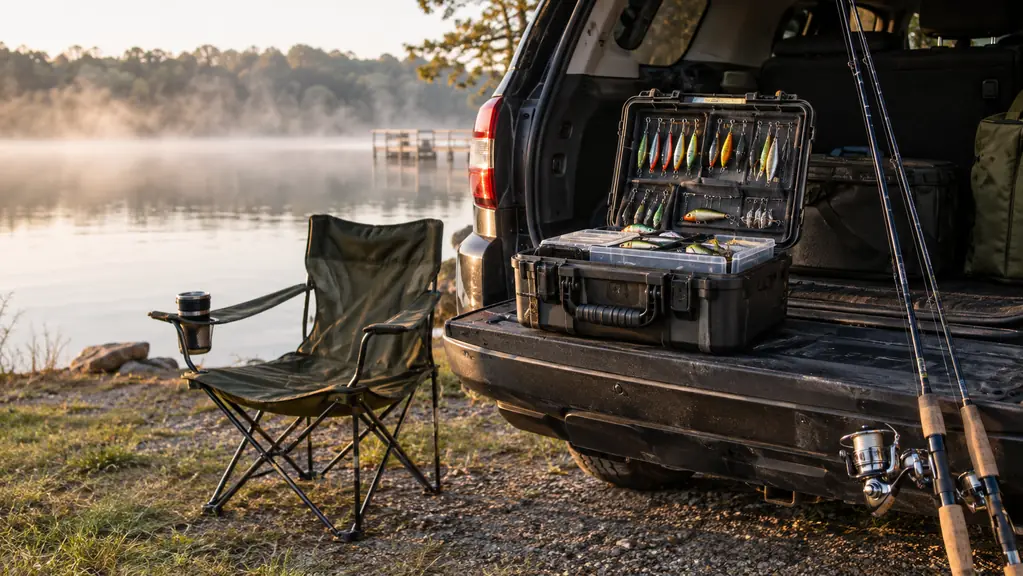
Here is the short answer, because I know you are either standing in a store aisle or scrolling on your phone with a child pulling at your sleeve. For bank and pier fishing with kids in tow, I would buy the Plano Angled Tackle System again tomorrow. I have owned mine since the first week of March, loaded with all three of its boxes, and it has ridden in the back of the Tahoe on every trip since. A soft tackle bag is not a bad piece of gear. I see several of them at the public piers around Ross Barnett every Saturday, and I understand why people carry them. But what works for one grown angler walking a long way is not automatically what works for a mom hauling gear for three kids.
Before March we had no tackle box at all. Hooks lived in zip bags, sinkers lived in the cupholder, and the whole arrangement depended on nobody sitting down on anything. Then came one cold Saturday in late February at the pier. The line kept coming off the kids' cheap combos in bird's nests, Ben cried, and we were back in the Tahoe inside an hour. When I unpacked that afternoon, loose hooks were rolling around the cargo area, under the grocery bags and a spare jacket. That was the entire reason I went looking. I ordered the Plano system that first week of March and sat at the kitchen table that night re-spooling three reels.
| Plano Angled Tackle System | Soft tackle bag | |
|---|---|---|
| What comes with it | Three 3560 Stowaway boxes, each with its own lid and latch, sitting in their own slots | An open main compartment and outside pockets. The boxes are bought separately. |
| Weight | 5.7 pounds with the three boxes in place, loaded light | Usually lighter, since it is fabric and holds no boxes of its own |
| Carrying it to the water | One molded handle. It hangs down and bumps your knee on a long walk. | Most have a shoulder strap, so it rides across the body and leaves a hand free |
| A wet bank or a pop-up shower | Hard shell. Water runs off the top and the box lids keep hooks dry. | Fabric soaks through. Zippers are the weak point in real rain. |
| Hooks staying where you put them | Each box is its own sealed compartment, so a size 8 hook cannot find the catfish sinkers | One open space. Loose hooks and loose line will eventually find each other. |
| When a kid drops it on gravel | Hard corners take the hit, the shell holds, and the latches stay shut | Lands soft, though an open zip spills the contents across the ground |
| Finding one bait while three kids wait | The lid opens and the boxes present at a 15 degree angle, so you see the fronts of them | You unzip and dig, or you unclip a box you bought and added yourself |
| Setting it down on uneven ground | Flat corners can wobble on a slope until you find a level spot | Conforms to roots and rocks and sits where you put it |
| Storing it at home | A fixed 18 by 9.5 by 11 inches that does not collapse when it is empty | Squashes flat onto a shelf |
| Best for | A family sharing gear who needs to see what they have at a glance | One angler walking far and carrying light |
Where the Plano Angled Tackle System Wins
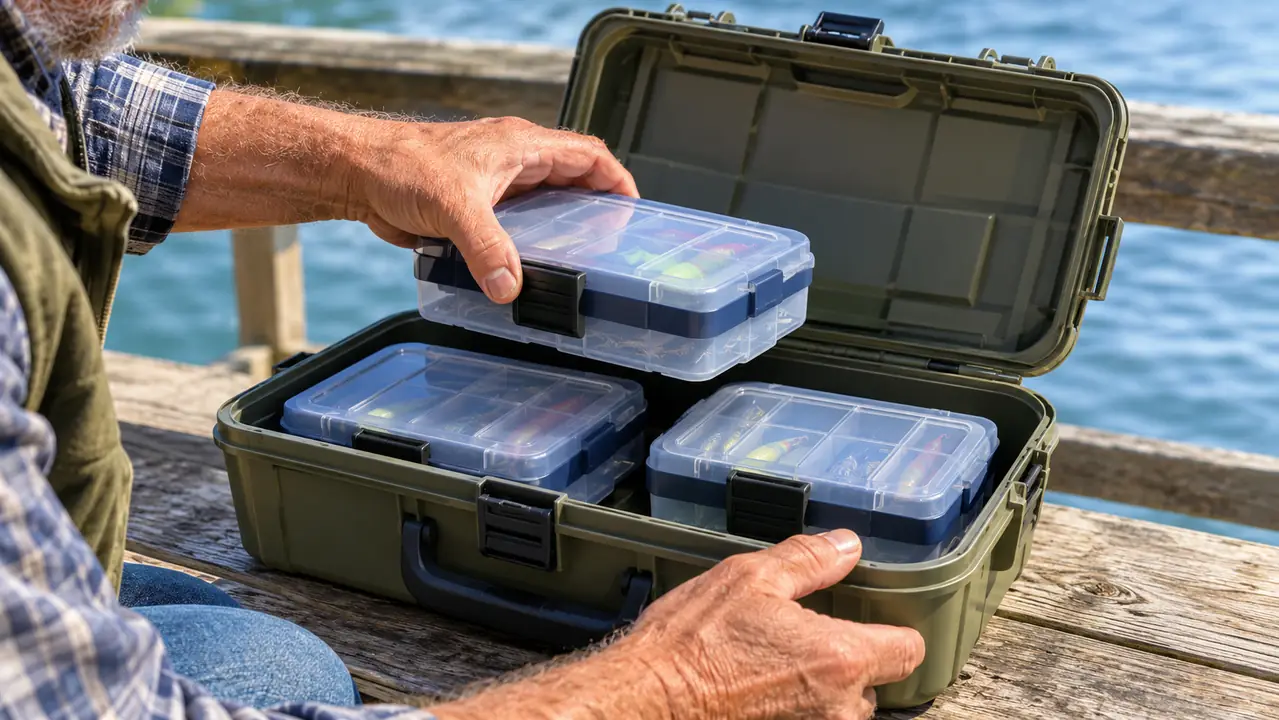
What sold me was sorting by job instead of by person. Box 1 is bluegill: small hooks, bobbers, split shot. Box 2 is crappie, and it holds the Crappie Magnet kit. Box 3 is catfish: bigger hooks and the heavier sinkers. Wyatt, who is 13, is the one who carries it and ties the knots, and even he can open the lid, look at three boxes I marked with tape, and know which one he wants. Our first trip with it was a Saturday in mid March at the pier, and Ben caught a bluegill on his first good cast. I am not going to credit a tackle box for a fish. What I will say is that we rigged four rods that morning in about ten minutes, because every hook and bobber was already in the box it belonged to and nobody had to dig. Callie rigged her own jig off box 2 without asking me a single question. The main compartment presents those utility boxes at a 15 degree angle. That reads like a catalog line until you use it. The lid comes up and you are looking at the fronts of the boxes instead of down into a dark well. The DuraView covers keep everything readable, and the latches are stiff enough that a nine-year-old has to mean it.
The other half of it is water. A hard shell sheds a shower. The lids on the 3560 boxes close with a snap, and I have opened the system after a wet morning at my aunt's pond and found dry hooks inside. It has been dropped on the concrete ramp, kicked across the tailgate, and left in a hot truck in July, and nothing has cracked or quit latching. It measures 18 inches long, 9.5 wide and 11 tall, which fits across the back of the Tahoe without sliding under a seat. There is a utility pocket on the outside where my clippers live. When gear is shared by four people, that structure is the entire point. One thing I did not expect: the boxes lift out, so on a quick evening trip I can pull the bluegill box, leave the case in the Tahoe, and walk down with one tray and two rods. That is a five second decision instead of a repack.
Where a Soft Tackle Bag Wins
I am going to be fair here, and I should say plainly that I have never owned a soft tackle bag. I am judging from what I watch at the pier and from listings, not from carrying one for eight months. What I see is a real advantage in weight and in hands. My system is 5.7 pounds with the boxes in it, loaded light. Ben is nine, and he can carry it from the truck to the picnic table and not much further. Most soft bags have a shoulder strap, so a grown angler can sling one across the body and walk a good distance with a rod in each hand. The walk from the parking lot down to the water at the reservoir is not short in July, and I feel that difference on the days I am carrying everything myself. There are people at the pier most Saturdays who carry a soft bag on one shoulder and a bucket in the other hand, and they are set up and fishing before we have the case open. They also walk in from the far lot, and I have never watched one of them make a second trip back to the truck.
A soft bag also wins on where it sits and where it lives. It conforms to roots and rocks and does not wobble on a slope the way a hard case with flat corners can. At home it squashes onto a shelf in a house that already holds three kids' worth of stuff, while my Plano takes up its fixed 18 by 9.5 by 11 inches whether it is full or empty. And if you are one person carrying one rod, a handful of jigs and a pair of pliers, the bag is simply less machine than you need.
The box that ended the loose hooks rolling around my cargo area
Three 3560 Stowaway boxes, a hard shell that sheds rain, and a lid that opens to the fronts of every box at 15 degrees. This is the one that has ridden in my Tahoe since March.
Amazon Check Today's Price on Amazon →How the Angled Boxes Actually Work
The system is one hard case built for three 3560 Stowaway boxes, and all three come with it. Each box has its own lid and latch, so the bluegill box can go to the picnic table while the catfish box stays in the case. The 15 degree angle is molded into the main compartment. When the outer lid comes up, the boxes lean back toward you instead of lying flat, and the fronts face the sky. That is the difference between finding a size 8 hook in four seconds and dumping half your tackle onto a pier plank while three kids watch. Before this I tried the obvious cheap version first: a gallon zip bag for hooks, a second one for sinkers, and a plastic shoebox for the rest. That lasted about two weeks. Hook points punctured both bags, the shoebox slid around the cargo area every time I turned a corner, and one warm afternoon the plastic latch popped open and emptied itself under the third row seat.
There are no wheels on it, so this is gear you carry by the molded handle rather than pull behind you. There are no drawers to jam and no fabric to soak. Water runs off the top. The utility pocket on the outside is where my line clippers and a spare spool live, which means I am not opening the main compartment every time somebody needs a tag end trimmed.
What it does not do is organize itself. The boxes are only as good as what you put in them. I marked mine with a strip of tape, one for bluegill, one for crappie, one for catfish, and I put the tape where a kid can read it while the lid is open. That took one evening and it is the reason the whole thing works on a Saturday morning when everyone wants to be fishing already.
The lid opens at 15 degrees and I can see every bluegill hook we own without lifting a single box.
What the Kids Actually Do With It
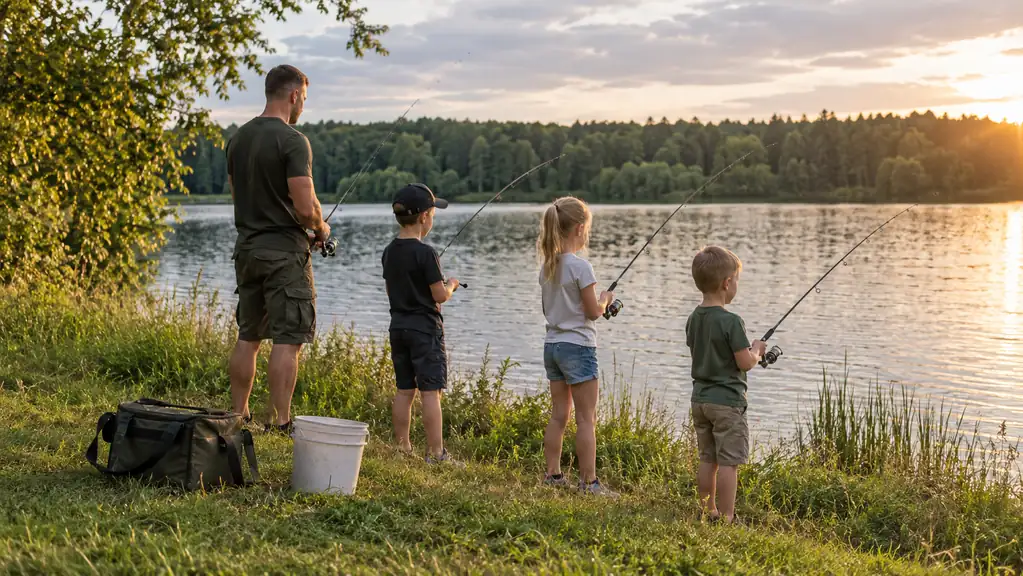
Their jobs are fixed, and the boxes fit the jobs. Wyatt carries the case and ties the knots. Callie rigs jigs out of box 2 because the Crappie Magnet pieces are small and she has the patience for them. Ben runs a bobber and a worm, and everything he needs is in box 1. He does not have to ask me where the bobbers went, and I do not have to stop rigging a rod to find them for him. That sounds like a small thing until you have spent a morning doing exactly that with three children and two hands.
The catch is that three kids in one case means somebody has to put things back. Our rule is that the last one to the truck checks all three latches and closes the outer lid, and I check it again before we drive off. It is not a system that stays tidy on its own. It is a system where tidy is easy, which is the next best thing.
What Eight Months in the Back of a Tahoe Did to It
Eight months in, nothing has broken. That is a low bar, so here is exactly what has happened to it. It has been rained on twice at the pond. It has been dropped off the tailgate onto gravel. It has spent July in a truck that gets hot enough to make a person rethink living in Mississippi. The hinges still line up, the latches still snap, and the boxes still slide into their slots. Nothing has been replaced since March.
The honest gripe is size and weight together. At 5.7 pounds loaded light, it is heavy for Ben and it is bulky in the cargo area next to three rods, a bucket and a cooler. There are quick evening trips on the way home from school where I leave the case in the Tahoe and carry one small box and a rod down to the water instead. That is not a knock on the case. It is just the truth about a hard box that holds three full trays. What I would watch if you buy one is the latches. Mine are still tight, but a latch that quits is the only failure I can picture, and it would happen at the worst possible moment. Check them before you load the case in the truck, the same way you check a knot.
Who Should Buy Which
Buy the Plano Angled Tackle System if you are the one organizing gear for more than one person. If kids share hooks and bobbers, if you want to know at a glance whether you are out of split shot, if your tackle rides in a vehicle and gets rained on, this is the shape of box that survives all of that. It is also the better pick if your gear lives in a garage or a shed between trips, because a hard shell does not care about a damp floor or a shelf that gets bumped. It is the easier box to take inventory of, too. Once a month I open all three trays on the kitchen table and count what is running low, usually split shot and size 8 hooks, and order before the next Saturday. That takes ten minutes and it has saved more than one morning.
Buy a soft tackle bag instead if you fish alone, walk a long way to the water and carry light. If you want a strap on your shoulder and a bag that folds onto a shelf, the bag is genuinely better at that and I am not going to pretend otherwise. Some families do both, and a soft bag with two small boxes inside is a reasonable middle. I went with the hard case because my problem was never the walk. My problem was hooks rolling around a cargo area and a nine-year-old who could not find a bobber.
Three boxes, three jobs, one lid
Bluegill, crappie and catfish, separated and marked with tape, and it has ridden in my Tahoe since the first week of March. If loose hooks in a cargo area is your problem too, this is the box I would buy again.
Amazon See the Plano Angled Tackle System on Amazon →