
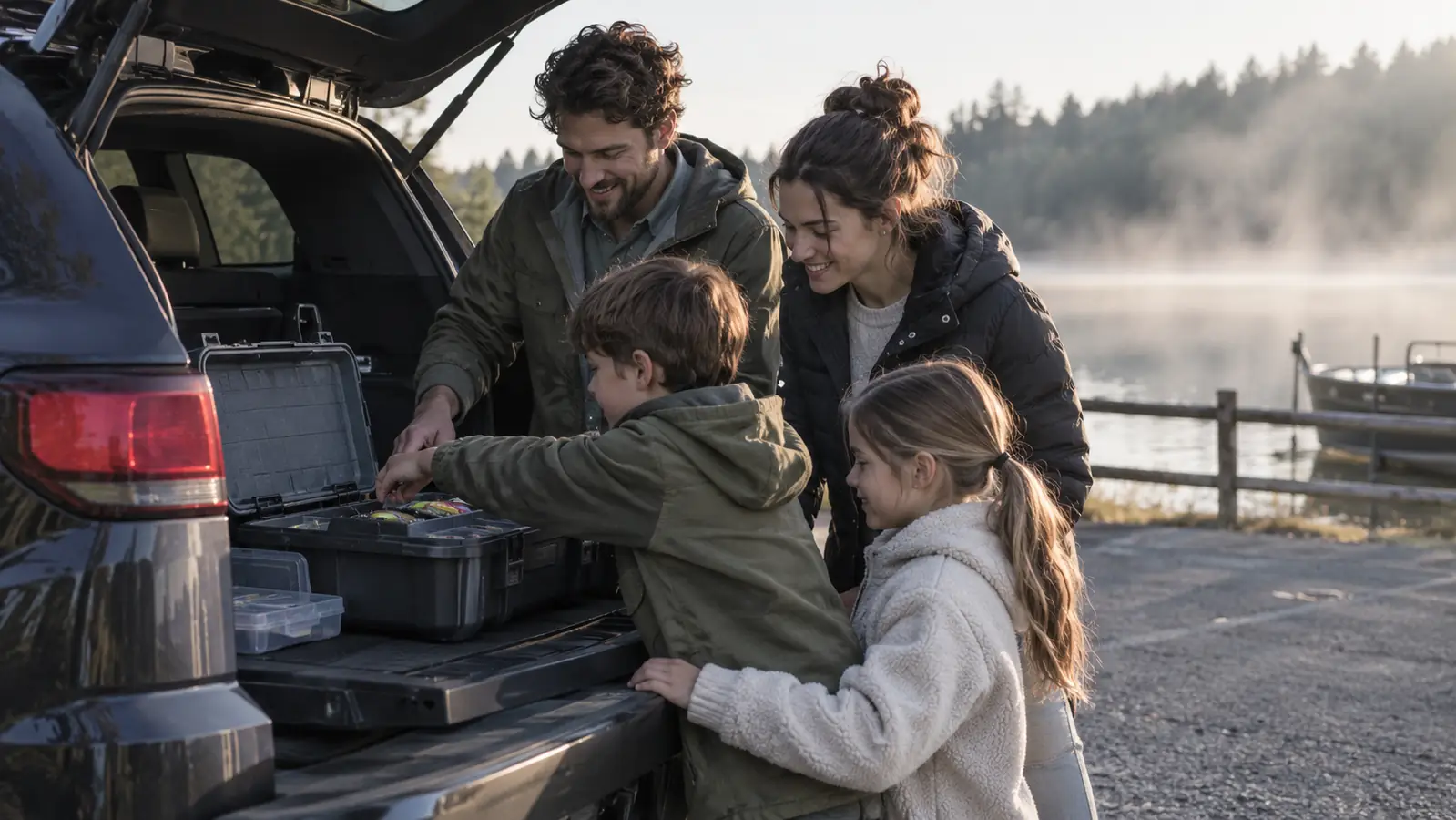
Three kids and one tackle box is a math problem that never solves itself. Somebody needs a split shot, somebody else needs a bobber, and the third one is standing there with an empty hook and a look on his face like the world has wronged him. Before you know it, the whole box is upside down on the pier planks and you are on your knees picking size 8 hooks out of the gaps between boards.
I know that scene because I lived it for years. I am Jolene Tarver, I live in Brandon, Mississippi, and I fish the bank and the public piers around Ross Barnett Reservoir with Wyatt, Callie and Ben. After one cold Saturday in late February when we quit early and I found loose hooks rolling around in the back of the Tahoe, I ordered a Plano Angled Tackle System with the three 3560 boxes and rebuilt the way we carry tackle from scratch. Here is the system we actually use, in five steps.
One hard case, three boxes, zero digging
The system that ended the tackle-box dig for a family of five: an angled hard case with three clear-lidded Stowaway boxes that each hold one job.
Amazon Check Today's Price on Amazon →Before You Start: What Is Actually Wrong
Almost every tackle mess I see at the pier is not a storage problem. It is a sorting problem. Somebody bought a big box, dumped every hook, weight, bobber, jig and swivel into it, and called it organized because the lid closes.
That works if you fish alone and have all afternoon to rummage. It fails the moment three kids are fishing at once, because each of them needs a different thing at the same time and none of them can find it. The fix is not a bigger box. The fix is deciding in advance that each compartment answers one question, and that the answer is the same every trip.
What that first failed attempt looked like in our house, so you can skip it. The empty zip bags that had been holding our tackle went into a shoebox, the shoebox went into a plastic tote with the sunscreen and the bug spray, and the tote rode loose in the back of the Tahoe. For two weeks I told myself it was organized because there was a container involved. Then I watched Callie pour the whole shoebox out on the pier boards looking for one jig head while Ben held a rod he could not bait, and I understood that a container is not a system.
Step 1: Sort by job, not by kid
The instinct is to give each child their own box. Do not do it. Three kids means three boxes of overlapping junk, three sets of duplicates, and three times the hunting, because each kid still owns a little of everything.
Sort by what you are fishing for that day instead. In our case the three Stowaway boxes in the Plano went to three jobs. Box one is bluegill: small hooks, bobbers, split shot. Box two is crappie, and that one holds the whole Crappie Magnet kit. Box three is catfish: the bigger hooks and the sinkers.
When Ben wants to fish a bobber and worm for bluegill, he opens one box. He does not touch the other two. That single decision removed most of the chaos in our family overnight, and it cost nothing but twenty minutes on the living room floor.
The living room floor part is not a throwaway detail. I started it on a Sunday afternoon in the second week of March with a bath towel on the rug so the split shot would not scatter into the carpet, and I sorted every hook by eye, one drawer of the old bag at a time. What surprised me was how much of the pile was junk I did not need: rusted hooks, three bobbers with cracked stems, a tangle of swivels I could not remember buying. Roughly a third of it went into the trash can. That alone made the boxes easier to live with.
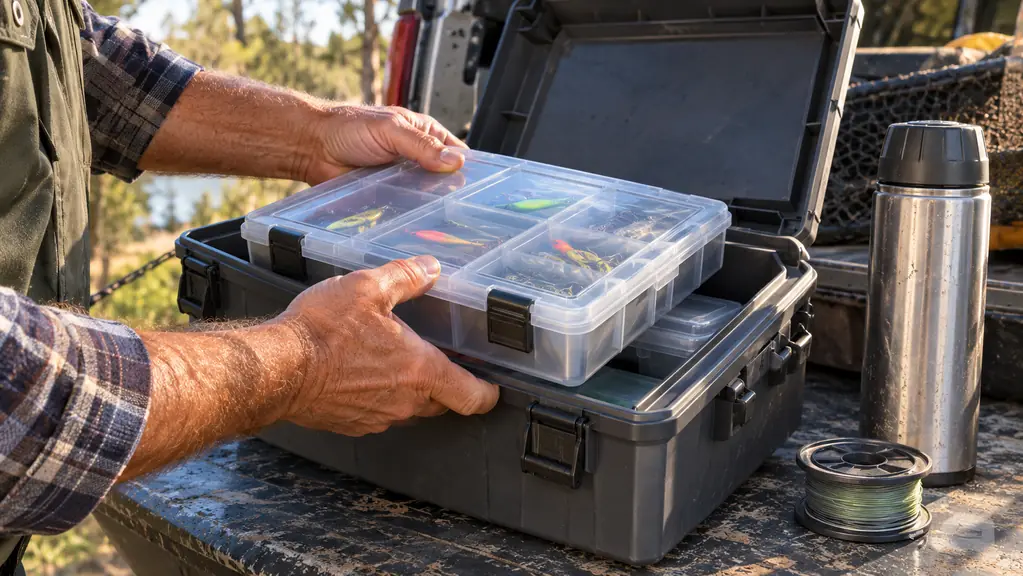
Step 2: Make the box lids readable at a glance
The Plano system helps here on its own, because the boxes have clear covers and doors. You can look down through the lid and see what is inside without opening anything. That matters more than it sounds when three kids are crowded around one tailgate.
I still labeled ours. A strip of masking tape on the end of each box with one word on it: bluegill, crappie, catfish. Ben is nine and reads fine, but at the water he moves fast, and a word he can see in two seconds beats a word he has to think about.
The label goes on the end of the box, not the top, so it stays visible when the boxes are nested in the case and the case is standing open. Small detail, big payoff.
My first attempt at this was a permanent marker written straight on the box end, and it smeared the first damp morning we had. Tape peels off clean when a box gets repurposed and a marker does not. Use a strip of tape and write on it twice, one word, big letters.
Step 3: Set the case up in the vehicle, not on the bank
One thing about the Plano case: it is a hard case, roughly 18 inches by 9.5 inches by 11 inches, and it weighs about 5.7 pounds loaded light. That is not heavy for me to carry, but it is heavy enough that I do not want Ben hauling it a hundred yards across a parking lot and then setting it in the mud.
So the case lives in the back of the Tahoe and gets opened there. The kids pull the one box they need, carry that to the water, and bring it back. A single box weighs almost nothing and fits in a jacket pocket or a bucket.
The case has a main compartment that presents the utility boxes at a fifteen degree angle, which sounds like a catalog line but really does help in practice. When it is open on the tailgate, you are looking down at the box edges instead of reaching into a dark well. Whoever is standing at the truck can see all three box labels at once and grab the right one on the first try.
The first Saturday we ran it this way, in mid March, I timed it without meaning to. Parked at the pier lot a little after seven, tailgate down, three boxes out, first cast by about ten minutes later. The February trip that started all of this had us on the bank for close to twenty minutes of digging before anybody got a line wet. Not a scientific measurement, just what the clock on the dash said.

Step 4: Assign each kid one physical job at the water
Storage gets you organized at home. Roles keep you organized at the water. Ours are fixed and everybody knows them.
Wyatt, who is thirteen, carries the case from the truck and ties the knots. Callie, eleven, rigs the jigs. Ben, nine, runs a bobber and a worm. Nobody does another person's job without asking, which cuts out about eighty percent of the arguing that used to eat our whole morning.
This is also why Wyatt carries it and not Ben. Thirteen can handle the weight and the responsibility. Nine cannot, and pretending otherwise is how you end up with a hard case on the toe of a sneaker.
The roles also give me a quick check. If I see Ben rigging a jig, I know something has gone sideways, because that is Callie's job and Ben should be at the bobber box.
One more thing about the roles, and this took me two trips to learn. A job has to come with the tool for that job, or the kid borrows it from the wrong box. Callie keeps her jig heads and her plastics in box two, the crappie box, and she knows that is where they live, so she never opens the catfish box hunting for a jig. Assign the job verbally and the box physically, and the two reinforce each other.
Step 5: Reset it the same afternoon, every single time
This is the step everyone skips and the reason tackle organization collapses in three weeks. Loading up at the water is not done until the boxes are closed, latched, and back in the case in the same order they came out.
I do the reset in the driveway before anybody goes inside. Ten minutes, in the daylight, with the tailgate down. Hooks get counted back into the right box, bobbers get gathered out of the cup holders, and the worn end of the line gets trimmed.
If you leave it overnight, you will find three hooks in the floorboard in April. I know, because that February Saturday is exactly how I found them, and I am not doing it again.
The reset is also where I catch damage before it costs us a trip. A bent hook, a cracked bobber stem, a split shot that has lost its grip. Those go in the trash in the driveway, not back in the box, and not into the water where the kids are standing. It takes an extra minute and it keeps the boxes honest.
We stopped sorting by kid and started sorting by job. Box one bluegill, box two crappie, box three catfish. Now Ben opens one box, gets his bobber, and is fishing in the time it used to take us to find the box.
What Else Helps
Getting the boxes right fixes most of it. A few other things filled in the gaps for us.
Line belongs on the reels, not in the case. I spooled all three reels with Berkley Trilene XL in six pound test at the kitchen table the night the boxes came, and that spool lives on a shelf in the garage instead of riding around loose. The case is for terminal tackle only.
Keep a dedicated hook remover and a small pair of pliers in the outside pocket, not buried in a box. Every case has that utility pocket, and it is the right home for the things you need in a hurry with a kid on the line.
Bring a small bucket or a cup for the kids who are too young to keep a box straight. Ben gets one box and one worm container. That is his whole kit, and keeping it that small is the reason it survives the trip.
Check your state's rules before anything else on a new water, because size and limit rules change by reservoir and by species, and it is not worth guessing with three kids watching you.
Two more small habits earned their place. First, dump and dry. If a box gets wet, which happens on a pier in spring, open it on the porch when you get home and let it air out before it goes back in the case. Second, keep one empty box slot spare. There is room in the case, and having a place to drop loose tackle you pick up during the day beats stuffing it in a pocket.
If you are sorting out gear for the first time, a small box for each job honestly beats one giant box for everything, and there is a whole case for that argument in the reasons a small tackle box beats a tackle bag for shore fishing. The principle is the same: fewer choices in front of a kid means faster decisions and less mess in the truck.
Loading up is not finished until the boxes are latched and back in the case in the same order. Ten minutes in the driveway beats twenty minutes of untangling in the dark.
Sort it once and stop hearing about it
Three clear-lidded Stowaway boxes at an angled fifteen degrees, so the right box is the first thing anybody sees. Rated 4.7 from more than 4,400 reviews.
Amazon Check Today's Price on Amazon →One honest note before you buy. This is a hard case and it is bulky. It is about 5.7 pounds loaded light, which is heavier than Ben can manage comfortably, and it takes up real space in the back of the vehicle. If your kids are all under ten, you will be the one carrying it. Plan for that.
But if the problem you have is three kids, one tackle pile, and a trip that keeps getting cut short while everybody digs, this is the fix. It is not clever and it is not expensive. It is three boxes, three jobs, and a lid that lets you see what is inside before you open it. That was all we needed.