
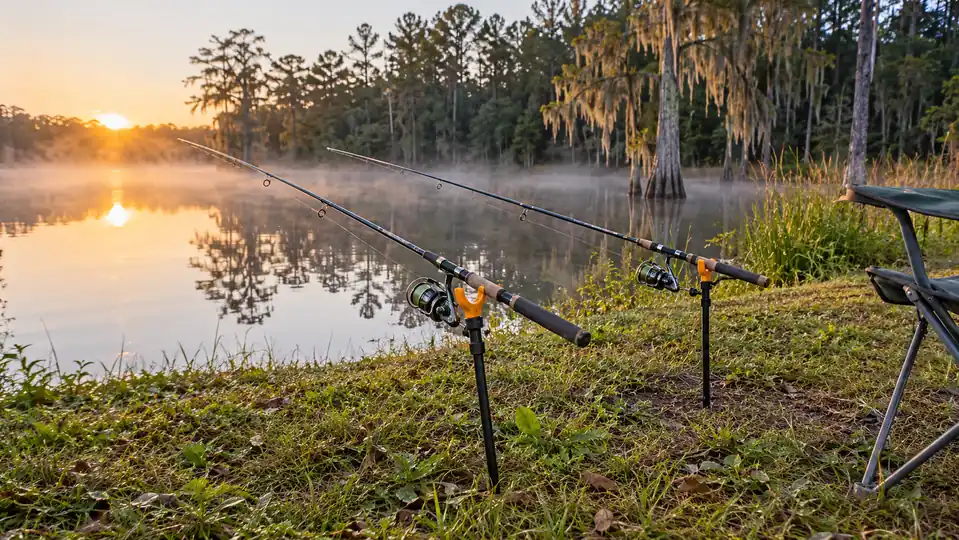
I bought these DZrudun rod holders in the first week of March this year, along with three kids' rods, a tackle box and a spool of line, because of one bad Saturday in late February at the pier. The line kept coming off the reels in bird nests the size of a fist, Ben was nine and crying about it, and we were back home inside an hour. When I unpacked the Tahoe that afternoon, loose hooks rolled out from under the back seat.
That is the entire reason I own them. No sponsor sent these, no friend works at a tackle shop, and nobody gave me a discount for saying something nice. I paid for the two pack out of my own account and they have ridden in the back of the Tahoe since March. Eight months in, I have a fair idea of what they do well and what they flat out will not do, and this is the version of a review I would want from a friend before she spends her own money on a piece of nylon and a stake.
The Quick Verdict
A ground holder that does the one job I bought it for, which is keeping two catfish rods upright on soft pond bank for hours at a time. It is real work to set in hard ground, it holds two rods and no more, and it will do nothing for you on a pier. Worth it anyway for bank fishing.
Amazon Check Today's Price →The stake is the whole reason these stay in my truck
A 12.95 inch tapered stainless steel stake, a reinforced nylon body, 360 degrees of horizontal and 130 degrees of vertical adjustment, and a one year warranty. The two pack ships with a storage pouch so the points are not loose in your back seat.
Amazon Check Today's Price on Amazon →What Nobody Tells You Before You Buy a Ground Holder
Every ground holder is sold on the same picture. You push it into the dirt, you set your rod in it, you sit down. What the picture leaves out is that the ground you actually fish is not one thing. At my aunt's pond the bank is soft black dirt down by the water and packed clay three steps up. The same holder in the same ten feet of shoreline is a different tool depending on where you put it. Almost every complaint I have ever heard about a rod holder is really a complaint about the ground.
The second thing nobody mentions is that this is a bank tool and nothing else. What you are buying is a stake with an adjustable head on top of it, and once you understand that, you can predict where it will work. Soft dirt, mud, the loose stuff at the edge of a pond after a rain, the sandy shoulder above a reservoir: fine. Gravel, rock, sun baked clay, the packed strip where the mower turns around: not fine. None of that is a defect in the DZrudun. It is what a ground mount is.
How I've Used Them Since Late March
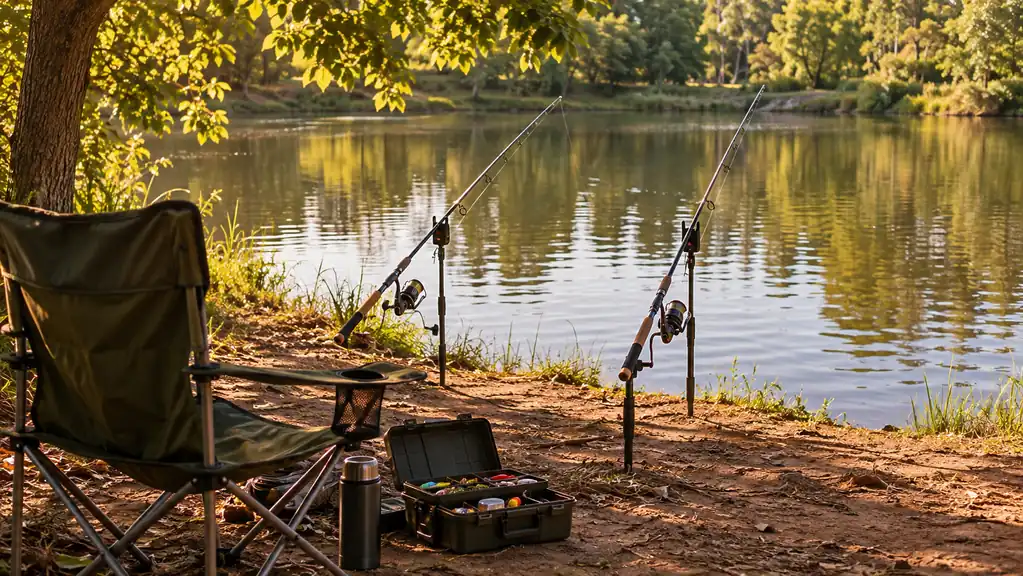
The first trip with them was a Saturday in late March at my aunt's pond, the same week the box came. I set both holders about twenty feet apart on the soft bank, worked the stakes in, dropped a catfish rig in each one, and sat down in a lawn chair with a cup of coffee. That is the entire test, and it is the one that matters. The rods stayed up. Ben ran back and forth behind me with a bobber and a worm, Callie had her jig rod out, and nobody had to hold anything for two straight hours.
Our routine has not changed much since. We get there, I pick two spots where the bank is soft enough to take a stake, I work them in, I set the angle toward the water, and then we bait up. Wyatt is thirteen and he carries the tackle box and ties the knots. Travis works rotating shifts and rarely comes along, so most Saturdays it is me and the three of them, which is exactly why I wanted something that would hold a rod without a person attached to it.
What it did not do is turn fishing into something you can walk away from. A rod in a holder still needs eyes on it. A catfish can drag a rod toward the water if the drag is set wrong, and no stake on earth fixes that. The holders also do nothing about mud, mosquitoes, or a nine year old who wants to reel in every thirty seconds. They hold rods. That is the job and they do it, but I do not want anybody reading this thinking they can set it and go sit in the truck.
The Stake Is the Whole Story
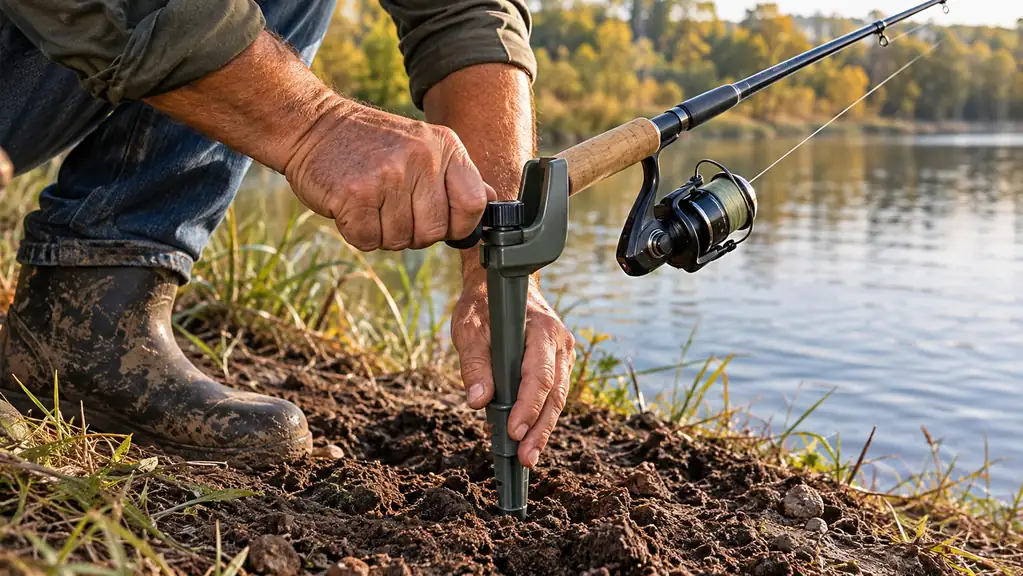
The stake on these is 12.95 inches of tapered stainless steel. The common ones I see at the reservoir look like they run closer to nine and a half inches, and that extra three and a half inches is not a marketing number. It is the reason these work on my aunt's bank. A short stake only reaches the loose top layer of dirt. A long one gets down into ground that has not been rained on and baked out yet. The taper matters too, because it lets you work the stake in without wallowing out a hole wider than the stake itself.
What that feels like in practice is boring, which is the point. With a forked stick, or with the short holder I borrowed once from a cousin, a good hit on a catfish rod makes the whole thing lean over. You look up and the rod is at an angle it was not at five minutes ago, and eventually it is flat in the mud. With these, a hit makes the rod tip nod and the stake stays where I put it. I have not had one pull over. Not once since March.
Now the flip side, because there always is one. A longer stake is more work to set and more work to pull. In the soft stuff down by the water it goes in with a push and a turn. Up on the packed clay I have to lean on it and work it back and forth, and my wrists are not what you would call strong. On a cold morning with the ground hard, setting two of these is a two minute job instead of a ten second one. I would still make that trade every time.
What the 360 and 130 Degree Adjustment Actually Buys You
The head turns 360 degrees horizontally and 130 degrees vertically. On a listing that reads like a line of spec sheet filler. In the real world it means I can set the stake where the ground is good and then point the rod wherever the water is, including off to the side or behind me, without pulling the stake and starting over. That matters more than I expected, because the good ground and the good water are not always in the same direction at that pond. The soft bank curves and the catfish hole is off to the left.
The vertical range is the other half of it. Sitting the rod low and close to the water is what I want for catfish, because the line goes out flat and the rod is not fighting the wind. Tipping it up is better when I want the line off the surface, or when the kids are fishing a bobber and I do not want the rod tip buried in the weeds. Between the two I can set either rod the way I want it without hunting for a different spot on the bank.
The Small Stuff: Pouch, Nylon, One Year
The two pack comes with a storage pouch, and I will admit I rolled my eyes at that until I used it. Loose ground holders in the back of a Tahoe with three kids and a tackle box are a scratched seat waiting to happen, and the stakes are pointed. The pouch keeps the pair together and keeps the points away from everything else. It hangs on a hook in the garage between trips, and it is the reason both holders are still a matched set eight months later.
The body is reinforced nylon and the pair measures 10.8 inches deep by 6.5 inches wide by 15.4 inches tall. They fit in the back next to the tackle box without eating a whole corner of the truck. That nylon has sat in a closed vehicle through a Mississippi summer, which is a real test of anything plastic, and it has not cracked or gone chalky. There is a one year warranty on them. I have not had to use it, and if that ever changes I will come back and say so.
Two Rods, and One Ground That Fights Back
Here is the gripe that actually affects my family. Two holders is two rods, and I have three kids. Somebody is always waiting, and Ben at nine is the one who ends up holding his rod in his hands while the other two are set. If I had it to do again I would have ordered the four pack, not because the two pack is bad but because three children is three children. If you fish alone, or with one buddy, two is plenty and the four pack would be wasted money.
The ground gripe is the one that will decide whether you like these or resent them. Gravel bars, rock and dry clay in July are a fight. I have stopped trying to set them on the gravel strip at the reservoir because it is not worth ten minutes of leaning and muttering. On soft bank they go in quick and hold all afternoon. If the places you fish are hard ground, the DZrudun is not the problem and a different holder will not fix it.
Why They Stay in the Truck on Pier Days
These are ground mount and that is the end of it. The public piers around Ross Barnett are wood planks over water, and there is no dirt to put a stake in, so the holders stay in the Tahoe on those days. I knew that when I ordered. What surprised me is how many people buy a ground holder and then get annoyed that it will not clamp to a rail. It will not. Nobody should sell you one that claims otherwise.
Our year splits cleanly because of it. Pond days and soft bank days, the holders come out and the rods get set. Pier days, they stay in the back and we fish with the rods in hand or leaned where the pier allows. That is a limitation of the design, not a flaw in the DZrudun, and knowing it before you order is the difference between being glad you bought them and being irritated in a parking lot.
What Eight Months Has and Has Not Changed
Eight months is not ten years, and I am not going to pretend I know how these look after a decade. What I can tell you is what eight months of real use in Mississippi looks like. They have been rained on, left out overnight twice by accident, hosed off in the yard, and stored in a hot truck between trips. Nothing has cracked, rusted through, or come loose at the adjustment points. The stakes have some scuffs on them. That is the whole list.
The one thing I do now that I did not do in March is rinse them before they go back in the pouch. Pond mud dries like concrete and the last thing I want is grit working into the joint that sets the angle. Thirty seconds with a garden hose has kept both of them moving freely. That is not a product flaw, it is me being lazy in March and paying attention by June.
What I Liked
- The 12.95 inch tapered stainless stake holds in soft bank where a short stake leans and lets go
- 360 degrees horizontal and 130 degrees vertical adjustment means I set the angle without moving the stake
- Reinforced nylon body has survived a closed truck through a Mississippi summer without cracking
- The storage pouch keeps the pair together and the points out of my back seat
- One year warranty, and mine have needed nothing so far
- Two holders cover two catfish rods for one person, which is the setup I actually fish
Where It Falls Short
- Ground mount only, so it is dead weight on the wooden piers around the reservoir
- Setting the stake in hard clay, gravel or rock is a genuine chore
- Two holders is the ceiling with the two pack, and three kids means somebody waits
- Mud dries in the adjustment joint if you do not rinse it before storage
- No way to use it from a boat, a dock or a rail
That extra three and a half inches of stake is not a marketing number. It is the difference between a rod that nods and a rod flat in the mud.
Who This Is For
Bank and pond anglers with soft ground and heavy rods. If you fish catfish off the dirt, set two rods and sit in a chair, this is the tool for that and nothing about it is complicated. It suits parents who want the kids' rods out of their hands while they bait hooks, and anybody who has cut a forked stick on the way to a spot and had it snap by noon. That was me until March.
It also suits anyone who wants two rods and no more, and does not want to think about gear again. Two holders, two rods, done. If that is your setup, the two pack is the simplest thing in the back of my truck and the one I would buy again without thinking hard about it. I have recommended it to two other moms at the school where I work, and both of them fish the same kind of soft bank I do.
Who Should Skip It
Pier, dock and boat anglers should skip it, and I mean that plainly, because it cannot do the thing you need. Same for anybody fishing rock, gravel or hard clay most of the year. You will fight it every trip and end up blaming the holder for a ground problem. And if you routinely fish four or six rods, the two pack will not cover you. There is a four pack in the same listing, and I would go straight to that rather than buy two two packs.
Skip it too if what you want is a rack that locks a rod down tight and holds it exactly where you put it no matter what hits. This is a stake with an adjustable head. You set an angle, it holds that angle, and a good fish makes the tip move. That is what a ground holder is, and it is worth being honest about that before you order one and expect something else.
If your bank is soft, this is the last forked stick you cut
Two holders, a storage pouch, a 12.95 inch stainless stake and a one year warranty. Mine have been in the truck since March and I would buy them again with one change, which is that I would order the four pack for three kids.
Amazon Check Today's Price on Amazon →