
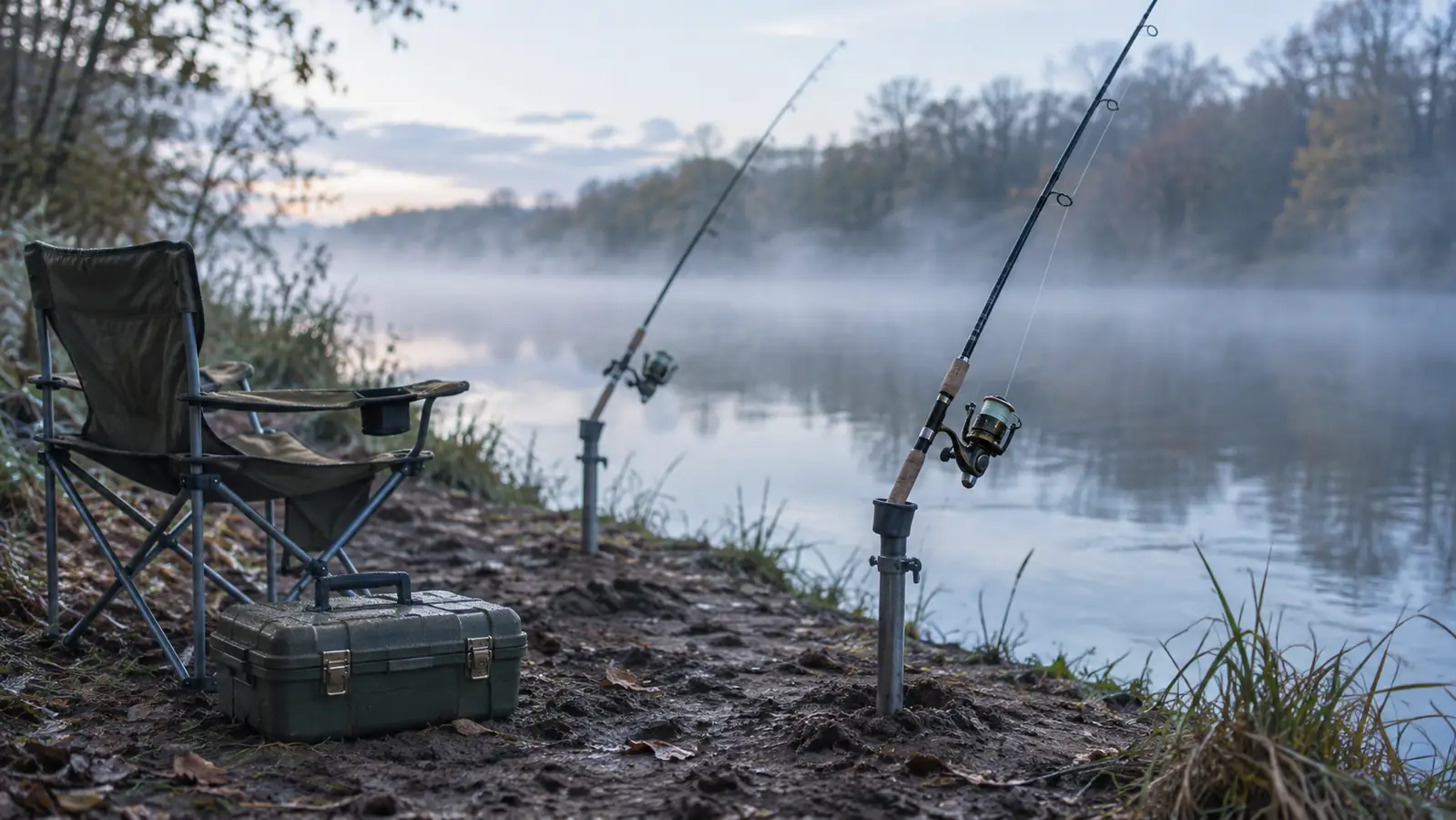
Two ways to keep a rod off the dirt while you wait on a catfish. You cut a forked stick on the bank, the way my grandfather taught me on a farm pond when I was small, or you push a DZrudun ground rod holder into the mud and set the angle where you want it. I have done both this year, on the same water, in the same spring, with the same three kids behind me asking how much longer until we eat. One of those two things is still riding in the back of my Tahoe. The other one is a stick I left on the bank in March and never thought about again.
Here is the short answer before the long one. For one rod, one afternoon, and a bank full of willow saplings, a forked stick works, and it costs nothing. For a family with two rods in the water and a nine year old who needs help baiting a hook every four minutes, the DZrudun does something a stick cannot do. It holds an angle. Not whatever angle the branch happened to grow into, an angle I picked, and it keeps holding it while a channel cat leans on the tip and the wind comes across the water.
| DZrudun Rod Holder | Forked Stick | |
|---|---|---|
| What it costs you | You buy it once and it stays in the truck | Free, if the bank has saplings |
| Setup on arrival | Push the drill stake in, set the angle, seat the rod | Walk until you find a fork, cut it, trim it until the rod sits right |
| Rod angle | 360 degree horizontal and 130 degree vertical adjustment | Whatever angle the branch grew at |
| Hold in soft mud | 12.95 inch stainless steel tapered drill stake | Sinks or tips over once the bank is wet |
| Hard, packed or rocky ground | Starting the stake is a chore in packed clay or gravel | Wedges between rocks where a stake will not start |
| Rods in the water at once | Two, from the 2-pack, set at two different angles | One per stick, and you can always walk for a second |
| After a season in the truck | Reinforced nylon, one year warranty | Dries out, splits, and gets left on the bank |
| Room it takes up | Listed at 10.8 by 6.5 by 15.4 inches, plus the pouch | Nothing to carry in, nothing to carry out |
| Small parts | The 2-pack comes with a storage pouch | Nowhere to put a spare hook |
| Best for | Two rods, a soft bank, and a family that wants to sit down | One rod, a short stop, and a bank full of saplings |
Where the DZrudun Rod Holder Wins
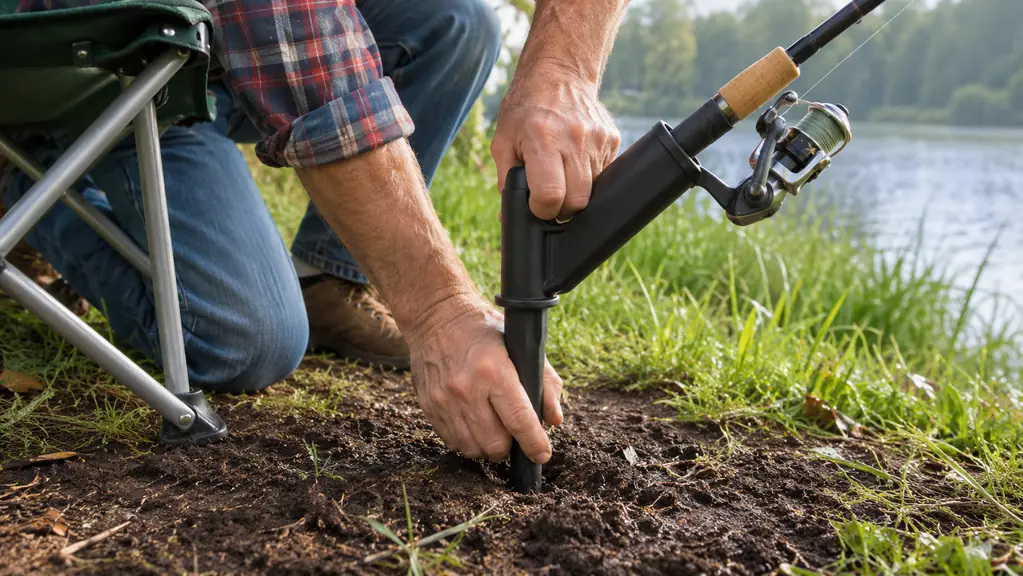
The stake is the whole argument. The DZrudun uses a 12.95 inch stainless steel tapered drill stake, and most of the ground holders I looked at before I ordered ran about 9.5 inches. Three and a half extra inches does not read like much on a product page. On a soft reservoir bank after a week of rain, it is the difference between a holder that leans over sideways and a holder that stands up when a fish turns with the bait.
The adjustment is the second thing, and honestly it is the reason I stopped cutting sticks. 360 degrees horizontal, 130 degrees vertical. What that means at the water is simple. I can point the rod away from the wind, lay the tip low for catfish, or stand it up so Callie can watch her bobber, and I never touch the stake again. With a stick I get one angle. If the wind shifts I get up, go find another stick, and the fish do not care that I am busy.
Back in April I had two rods out on the soft bank at the reservoir on a weekday evening, the kind where the wind comes across the water from the west and does not quit until dark. With a stick, that wind pushes the rod tip around until the line is bowed and you cannot tell a bite from a gust. That evening I turned both holders, dropped the tips low, and the line sat where I put it. Callie watched her bobber. Ben watched nothing at all. I watched the two rod tips. When one of them pulled down and stayed down, I knew it was a fish and not the wind, and I picked the rod up out of the holder instead of untangling it from a branch.
The build is reinforced nylon, and the pair carries a one year warranty. My 2-pack also came with a storage pouch, and the listings run in 1-pack, 2-pack and 4-pack sizes. That pouch sounds like filler until you have had loose hooks rolling around the back of a truck, which is exactly how my February went and exactly why I went looking for a better way to carry things.
What I Liked
- Holds a rod at the angle I set, not the angle a branch grew at
- 12.95 inch tapered drill stake keeps its footing in soft bank
- Two holders in the 2-pack, so two rods sit at two different angles
- Storage pouch gives spare hooks and swivels a place to live
- Reinforced nylon survives a summer in the truck, with a one year warranty
Where It Falls Short
- Starting the stake in packed clay or gravel is real work
- Only two rods, so a third rod still ends up in the grass
- Does not work on the wooden piers we fish, so they stay in the Tahoe on pier days
Three and a half extra inches of stake is nothing on a product page. On a soft April bank it is the difference between a rod that leans and a rod that stands.
Where the Forked Stick Wins
It is free, and it is already there. I want to be fair about this, because a stick got me through plenty of afternoons at my aunt's pond before March. You walk the bank, find a fork about hip height, cut it with a pocket knife, and you are fishing. Nothing rides in the truck. Nothing gets forgotten on the kitchen counter. Nothing gets lost.
The stick also wins on ground where the stake will not start. Packed clay, gravel bars, the rocky point on the north side where the bank turns hard, I have stood there with the holder and pushed until my palms hurt and gotten nowhere useful. A stick wedges between two rocks and holds fine. That is a real advantage and I am not going to pretend it is not.
I still cut one sometimes, and I will tell you exactly how it goes. Last month at the pond I had a third rod and only two holders, so I walked the treeline looking for a fork. It took six or seven minutes to find one at the right height with a crotch wide enough for the rod butt. Then I trimmed it with my pocket knife, worked it into the ground, and the rod leaned left because the fork was not cut square. I fixed that by wedging a rock under the butt end. It held for about an hour and then the rod rolled sideways. That is a stick. It works, and it works a little crooked, and you accept that because it costs nothing and it is right there.
Then there is the part where you leave it behind. If a stick gets left on the bank, nobody cares. It goes back into the dirt and becomes the bank again. If I leave one of my holders behind, I am out a piece of gear I paid for and I have to explain the whole thing to Travis.
The Two Things That Bug Me About the DZrudun
First, that stake. Everything I just praised about the length is also the thing that makes setup a chore in hard ground. At the farm pond the soil is soft and the stake goes in with one steady push. At the reservoir there are spots where I have to work it, lean on it, and wiggle it, and I have gotten my hands dirty doing it. If you fish ground that is packed hard or full of rock, you are going to feel that in your shoulders.
Let me be specific about that. There is a stretch on the north side where the bank turns to packed clay and gravel. I have stood there with the stake in both hands, leaning my weight on it like a shovel, and it went in maybe three inches and stopped cold. I moved four feet down the bank and it went in clean on the first push. So it is not that the holder fails. It is that you walk the bank testing ground before you commit, and that is a minute or two of your evening you did not plan to spend. The pond never does that to me. It is the reservoir spots that do.
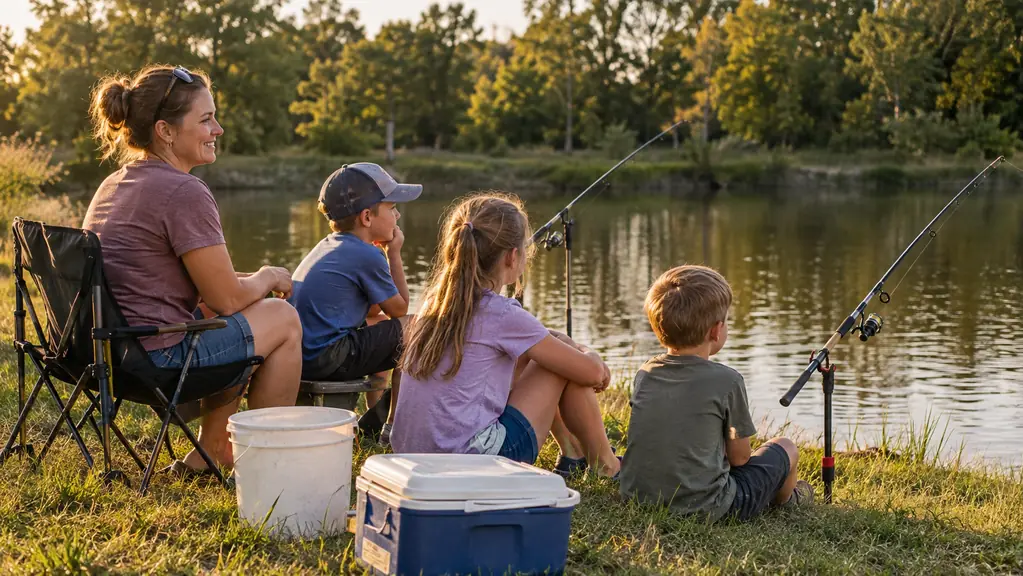
Second, two rods is the limit. The 2-pack gives me two holders, which is two rods, which sounds like enough until Wyatt wants his rod out too and I have three kids and three rods and one holder left over. A third rod goes in the grass and gets watched carefully. I knew that when I ordered. It does not mean it does not annoy me.
On our last Saturday trip the catfish rod sat in one holder, Wyatt had his rod in the second, and Callie decided she wanted to soak a bobber too. Her rod went butt-first in the grass with the tip propped on the tackle box, which is not a technique anybody should copy, and I checked it about every two minutes. Nothing bad happened. But that is the trade-off of a 2-pack, and if you routinely fish three rods at once you would be looking at the 4-pack, which I do not own and cannot vouch for past what the listing says.
What Changed at My Aunt's Pond
The switch happened on a Saturday in late March at my aunt's pond, the first time I used the holders. I had two catfish rods out and I wanted to sit down with a cup of coffee for ten minutes, which is a thing I had not done on a bank in years. With sticks, the rods are fine until a fish takes, and then they are not, because the rod is lying across a fork with nothing holding the butt end. I pushed both stakes in, set one rod low and one rod up, and sat down.
That pond is a fair test because the bank is soft and the water is shallow at the edge, so you can see the bottom and see where the stake goes. The first one I set about two feet from the waterline, tipped the head back, and slid the rod in from the top. It went in with one push. The second I set six feet further along, closer to the shade, because that is where the fish bit for my grandfather thirty years ago and I am sentimental about it. Two holders, two angles, one folding chair in the middle of them, and Ben in the chair within about a minute.
That was the whole test. Nothing dramatic happened. Nobody caught a monster and I am not going to tell you a story about a trophy fish. But I drank the coffee hot, which does not sound like gear review material until you have poured out a third cup because you were wrestling a rod out of a stick with one hand.
The holders have lived in the truck since. They go to the pond and to the soft bank at the reservoir. They stay home on pier days, because a ground holder has no job on a wooden deck and I will not tell you it does. Backing up for a second, I bought all of it in the first week of March with my own money, after a cold February Saturday when three cheap combos bird nested, Ben cried, and we went home after an hour. That is the trip that made me spend. Eight months in, the holders are the piece I reach for most.
Two Rods, One Stake, No More Cutting Sticks
The 2-pack is what I use: one holder for the catfish rod and one for whoever is fishing with me. The 12.95 inch drill stake and the 130 degree vertical adjustment are why it beats a stick on a soft bank.
Amazon Check Today's Price on Amazon →Who Should Buy Which
If you fish from a soft bank or a farm pond and you usually have more than one rod out, buy the DZrudun. That is the job it was built for. A parent with two kids and two rods, ground that gives when you step on it, and a day where you would actually like to sit down for five minutes. The 2-pack is the size that makes sense for that. If it is just you and one rod, the 1-pack covers it.
If you are stopping for twenty minutes at a rocky point, or you walk in a long way and count every ounce in the bag, cut a stick. It costs nothing, it works, and the bank grows them. And if you fish the wooden piers more than you fish the bank, neither one of these is your answer, and you probably already knew that before you started reading.
The Holder That Stays in the Tahoe, Not the Stick I Left on the Bank
Same bank, same fish, same three kids. I set the angle once, seated the rod, and sat down with a hot cup of coffee. Eight months in, nothing has broken and nothing has been replaced.
Amazon See Today's Price on Amazon →