
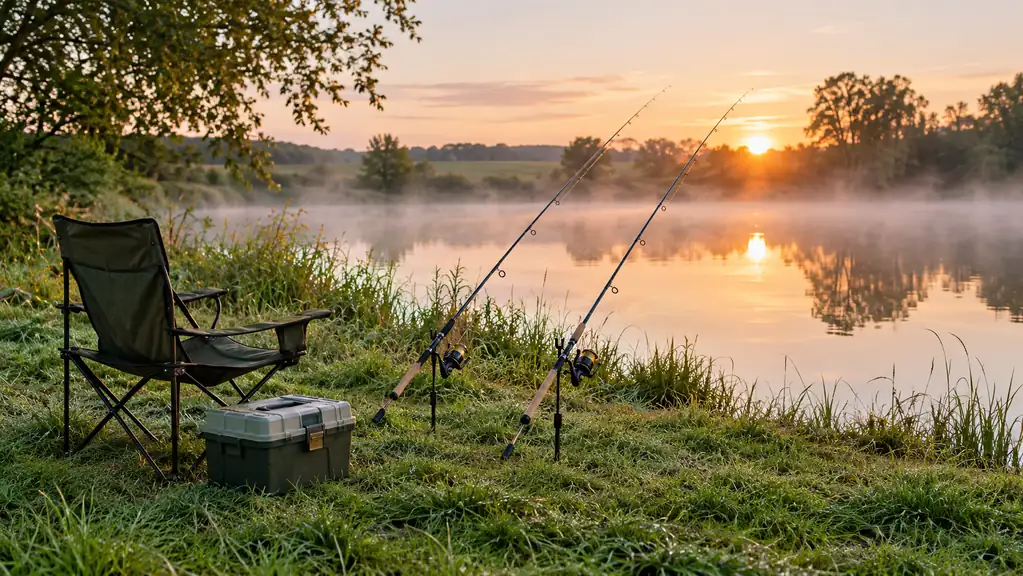
The last Saturday in February, I loaded Wyatt, Callie, and Ben into the Tahoe and drove to the public pier at Ross Barnett Reservoir. It was cold enough that the kids kept their hands in their pockets. The line on the old cheap combos kept jumping off the spools in bird nests. Ben got one tangled so bad he sat down on the pier and cried. We were home before lunch. That afternoon I found loose hooks rolling around in the back of the Tahoe, and I decided the gear was part of the problem.
I ordered the DZrudun rod holder 2-pack the first week of March, along with the rest of the gear I will write about on this site. I paid for it myself. My husband Travis works rotating shifts and rarely fishes with us, so I am the one who packs the Tahoe, picks the spot, and untangles the line. I needed something that would hold a rod while I helped Ben with a bobber or baited a hook for Callie. The DZrudun holders have ridden in the back of the Tahoe for about eight months now. Here is what they have done and what they have not.
The Quick Verdict
A sturdy two-pack for soft bank and farm pond fishing. The long stake holds, the angle adjusts by hand, and it has survived eight months of kids. It is not a pier tool and two rods is the limit.
Amazon Check Today's Price →Keep both catfish rods off the dirt while you help the kids
The DZrudun 2-pack sets two rods in the bank at the pond or on soft ground at the reservoir. Check today's price on Amazon.
Amazon Check Today's Price on Amazon →How I've Used It
The first trip with the holders was a Saturday in late March at my aunt's farm pond. I set up two catfish rods on the soft bank, one for me and one for Wyatt, since he is thirteen now and likes to fish with his own rig. The ground there is soft and dark, the kind that holds moisture most of the year. I pressed the stake in with my hand and a little weight from my foot, and both holders stood up straight. For the next two hours I baited hooks, retied a knot for Ben, and opened juice boxes. The rods stayed upright the whole time.
I tried the holders at the reservoir the next weekend and got it half wrong. I set them on a section of bank that looked flat but was packed hard from foot traffic, and the stake on the left holder went in about four inches and stopped. The rod leaned. I moved ten feet to a spot where the grass grew thicker and the ground was softer, and both stakes went in up to the holder body. That was my lesson for the season: the holder is only as good as the patch of dirt you pick. Now I walk the bank before I unload anything and press my heel into two or three spots first.
One weekday evening in May, the kids and I stayed until the light went orange. I had the two holders set with catfish rods and Ben was working a bobber and worm off to the side. A fish took the left rod hard enough that the rod tip bounced against the holder, and I got to it before anything moved. That is the whole reason I bought these. I was fifteen feet away sorting out a tangle for Callie, and the rod was still standing exactly where I left it.
At the reservoir I use the DZrudun holders on the soft bank, not on the wooden piers. The piers are where we go when the kids want to drop a line close to the structure, but a ground stake has nothing to bite into on a wooden deck. On pier days the holders stay in the Tahoe. On bank days they earn their space. I have used them on the bank below the dam, on a grassy point near the campground, and on the red dirt bank at my aunt's pond. The pond is still the best test because the bank slopes and the kids run around behind the rods.
Before this I cut forked sticks on the bank and pushed them into the mud. I also laid rods in the grass more times than I want to admit. A forked stick works for about ten minutes. Then the rod tips over, or the fork is too wide, or the stick snaps. The DZrudun holder is not fancy, but it does the one job I need. It keeps the reel out of the dirt and the rod pointed where I set it.
What the DZrudun Rod Holder Actually Is
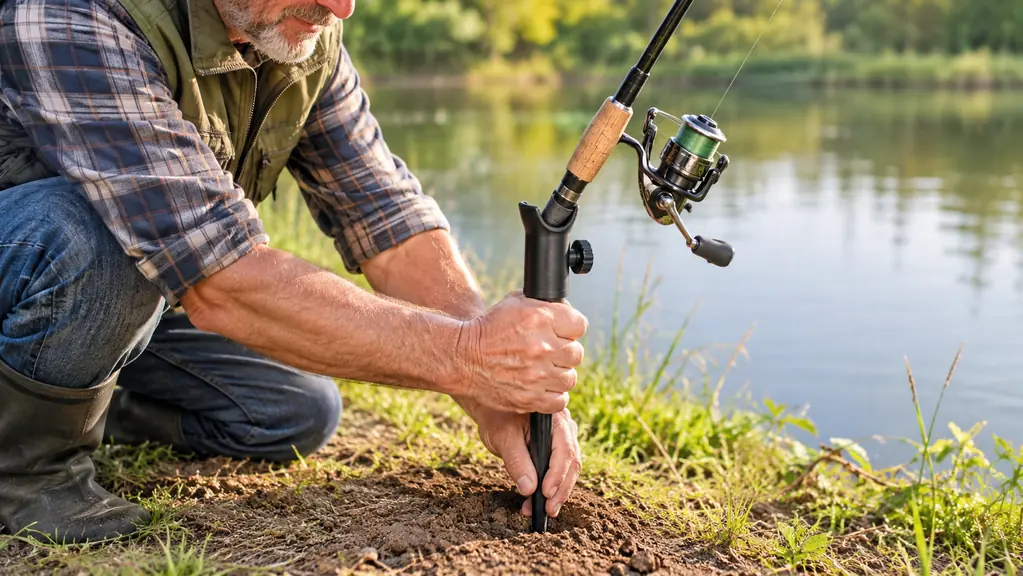
The DZrudun is a ground mount rod holder made from reinforced nylon. The package I bought is the 2-pack, and it came with a storage pouch. The stake is stainless steel, tapered, and 12.95 inch long. The holder body measures 10.8 inches deep by 6.5 inches wide by 15.4 inches tall. The listing says it has a 1-year warranty. It also comes in 1-pack and 4-pack options, but I bought the 2-pack because I only have two catfish rods that need holding at the pond.
This is not a clamp and it is not a rail mount. It does not attach to a pier, a boat, or a cooler. It is a stake you push into the ground, and the holder sits on top of that stake. That sounds plain, and it is. The value is in the length of the stake and the angle adjustment. If you need a holder for a wooden pier or a dock, this is the wrong tool. If you fish from a bank or a pond shore, it is the right shape of tool.
The storage pouch matters more than the listing makes it sound. Two loose holders with long pointed stakes rattling around in the back of a Tahoe with three kids and a hard tackle box is a bad arrangement. The pouch keeps them together and keeps the points covered. I hang it off a hook by the back window and it has not torn out. When I get to the bank, I pull both out at once instead of digging for the second one, which on a Saturday morning is worth something.
The Stake Is the Whole Story
The listing makes a point about the stake, and it is the right point. The DZrudun stake is 12.95 inch long, and the listing compares it to common 9.5 inch stakes. I have not owned the shorter ones, but I can tell you that the extra length matters on a bank that slopes toward the water. When I push the DZrudun stake in up to the holder body, the rod sits steady. I do not have to baby it. When a catfish takes the bait, the rod loads up and the holder leans a little, but the stake stays put.
The stake is also the main chore. At my aunt's pond the ground is soft and the stake goes in easy. On the reservoir bank it depends on the day. After a dry week the top few inches can be hard, and I have to work the stake in with a twisting motion and some weight. On a bank with rocks or roots, I have to hunt for a soft spot. That is not a defect in the holder. It is what a ground stake is. If your bank is all rock, this will frustrate you.
July was the hard test. We had a stretch of dry weeks and the bank at the reservoir baked solid on top. The stake did not want to start at all. I got it going by pressing the tip into a crack in the dirt and rocking it while I leaned my weight down through my heel. Once it broke through that crust, the ground underneath was still soft and the stake went in to the body in a few seconds. It took me maybe a minute of work, which on a Saturday with three kids waiting is fine.
The long stake is the reason I trust it. On soft bank, the holder does not tip when a catfish takes the rod.
The Angle Adjustment, in Real Life
The holder gives you 360 degrees of horizontal adjustment and 130 degrees of vertical adjustment. In plain terms, you can point the rod toward the water, toward the side, or nearly straight up, and you can tilt the tip up or down. I set mine so the rod tip is a little above the water line and the reel sits low enough that I can reach it from my folding chair. Callie likes hers pointed more toward the middle of the pond. Wyatt changes his depending on where he casts.
The adjustment is not something I fiddle with all day. I set it once when I set up, and I check it after a big fish or after Ben bumps the rod. The holder stays where I put it. That is all I ask. I do not need a precision instrument. I need a holder that keeps the rod in the same place while I do three other things.
Wind is the other thing the angle adjustment helps with. In April we had a morning where the wind came across the pond and pushed the rod tips sideways. I turned both holders so the rods pointed more into the wind and tilted the tips down a little. The rods still moved in the gusts, but they did not shake themselves loose. I would not call the holder a wind solution. Being able to change the angle by hand, with no tools and no wrench, made that morning a whole lot less annoying.
Where It Works and Where It Doesn't
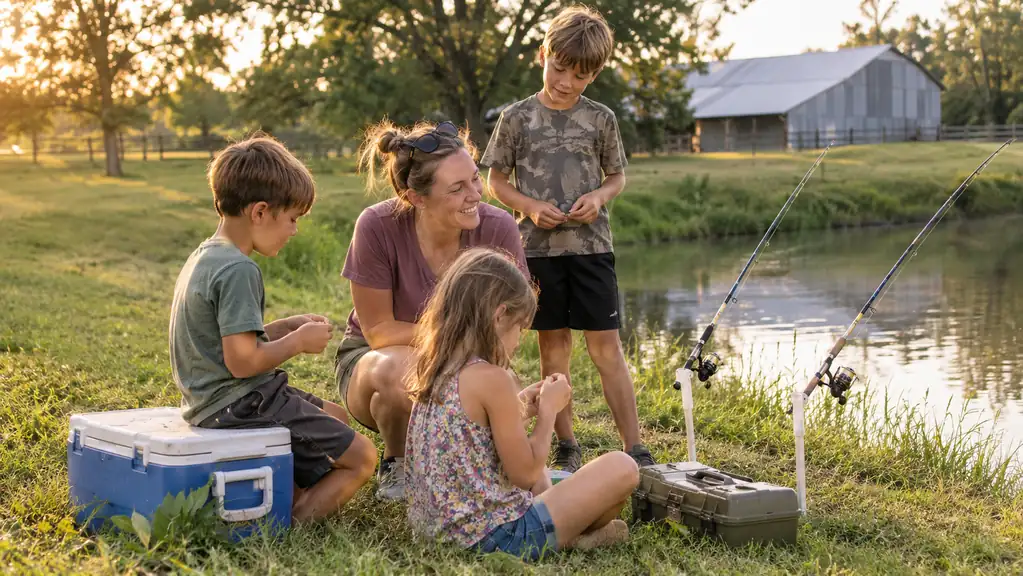
It works where the ground works. Soft bank, farm pond shore, grass, dirt, and sand that packs. It does not work on the wooden piers at the reservoir, and it does not work on a dock. I have seen people at the pier use clamp-on holders that bolt to the rail. That is a different tool for a different job. If you fish both the bank and the pier, you may end up with two kinds of holders. I did not. I just leave the DZrudun in the Tahoe on pier days.
The second limit is capacity. A 2-pack is two rods. With three kids and me, that is not enough for everyone to have a rod in a holder at once. In practice, Ben is nine and still wants to hold his own rod most of the time. Callie and Wyatt are old enough to set a rod and wait. Two holders cover the two rods that are actually fishing while I help with the third. If you need four rods in holders, buy the 4-pack or buy two 2-packs.
How It Has Held Up Since March
Eight months in, nothing has cracked, bent, or gone missing. The holders have been in the back of the Tahoe through heat, rain, and a few trips where I did not rinse them until the next week. The stakes still go into the ground the same way. The angle adjustment still holds. The storage pouch has kept the two holders together, which sounds small until you have dug through a vehicle looking for one holder on a Saturday morning.
In June I left both holders in the back of the Tahoe for two weeks straight through heat and a couple of thunderstorms. When I pulled them out, the pouch had grit in the bottom and the stakes had a light film on them. I wiped them down with a rag and that was it. Nothing stiffened up. The nylon did not go chalky or brittle the way cheap plastic does after a summer in a vehicle. I check the stakes for bends every few weeks by rolling them across the tailgate, and they are still straight.
I rinse the mud off after pond trips and let them dry in the sun before they go back in the bag. That is the only care they get. I have not had to tighten anything or replace a part. The 1-year warranty is there, but I have not needed it. For a piece of gear that lives in a vehicle and gets pushed into the dirt, that is a good sign.
What I Liked
- 12.95 inch stainless steel tapered stake holds in soft bank and pond shore
- 360 degree horizontal and 130 degree vertical adjustment lets you set the rod angle
- Reinforced nylon body has survived eight months of family use
- 2-pack with storage pouch keeps both holders together
- 1-year warranty backs the purchase
Where It Falls Short
- The stake is hard work in rocky or dry hard ground
- Only two holders per 2-pack, so a family of four needs to share
- It is a ground mount only and does nothing on a wooden pier
- You have to check the angle after a big fish or a kid bumps the rod
Who This Is For
This is for the parent who fishes from the bank with kids and needs a free hand. It is for the farm pond angler fishing for catfish or bluegill who is tired of cutting forked sticks. It is for the person who wants a simple ground holder with a long stake and a real angle adjustment. The DZrudun 2-pack fits that job. I keep a license and check the state rules each spring, and I keep the holders in the Tahoe from March through the fall.
Who Should Skip It
Skip it if you fish from a wooden pier, a dock, or a boat. Skip it if your bank is solid rock or roots and you cannot find a soft spot to push a stake. Skip it if you need four rods in holders at once, unless you plan to buy two packs. And skip it if you want a holder that clamps to a rail. The DZrudun is a ground tool, and it is honest about that. For the bank and the pond, it has done everything I bought it to do.
A free hand at the bank is worth more than another rod
The DZrudun rod holder 2-pack is what I keep in the Tahoe for pond days and soft bank trips. Check today's price on Amazon before your next Saturday.
Amazon Check Today's Price on Amazon →