
Here is the short answer, then I will show my work. If the jigs are mostly for kids fishing off a public pier or a pond bank, buy the Crappie Magnet Best of the Best Kit. If the jigs are for you, and you already know exactly what you want to tie on, a small bag of loose jig heads and plastics off the bait shop peg will cost less and fit you better. I own the kit. I fished loose for two springs before it. Both live in the same tray now, and I reach for them for different reasons.
I ordered the Crappie Magnet kit the first week of March this year, along with a tackle box and new line, all at once, paid for with my own money. That is about eight months ago. The loose jig heads and mismatched plastics I used before that came off the pegs at the bait shop one or two at a time, whatever was still in the bin that week. So I am not guessing about either one. This is bank and pier fishing at Ross Barnett with three kids, and the question I actually care about is not which one catches more fish. Both catch fish. The question is which one still works when a 9-year-old is holding the rod and a 13-year-old is doing the knot.
I should say what we fish for, because it matters. Bluegill, crappie and catfish off the bank and off the public piers, plus a small farm pond that belongs to my aunt. No boat. We have never fished from a boat and I am not going to write about it like we have. The kit is a crappie and bluegill tool. It is not a catfish answer. If your whole trip is catfish, you are paying for pieces you will not tie on, and I would rather tell you that up front.
| Crappie Magnet Kit | Loose jig heads and plastics | |
|---|---|---|
| Cost per fishable rig | Bought as a set, so the per rig cost is locked in by the box | Cheaper per piece at the peg, especially when you only need a few |
| Heads that fit the bodies | Double Cross jig heads sized to go with the kit bodies | You match them yourself, and sometimes they do not match |
| Picking one exact size for the day | One lineup, so you fish what is in the tray | You can grab the weight and profile the water is asking for |
| Organization | One tray, everything in compartments, lid shuts | Heads and bodies migrate to the bottom of the bag |
| Kid can rig it alone | Callie rigs her own at 11 without asking me for help | Needs an adult to sort out a head and a body first |
| Floats included | E-Z Crappie Floats come in the box | Usually a second stop at the peg |
| Room in the tackle box | A 115 piece tray takes a full compartment | A sandwich bag of loose jigs fits in a pocket |
| Best for | Families and new anglers who want one decision | Anglers who know their water and buy only what they use |
Where the Crappie Magnet Kit Wins
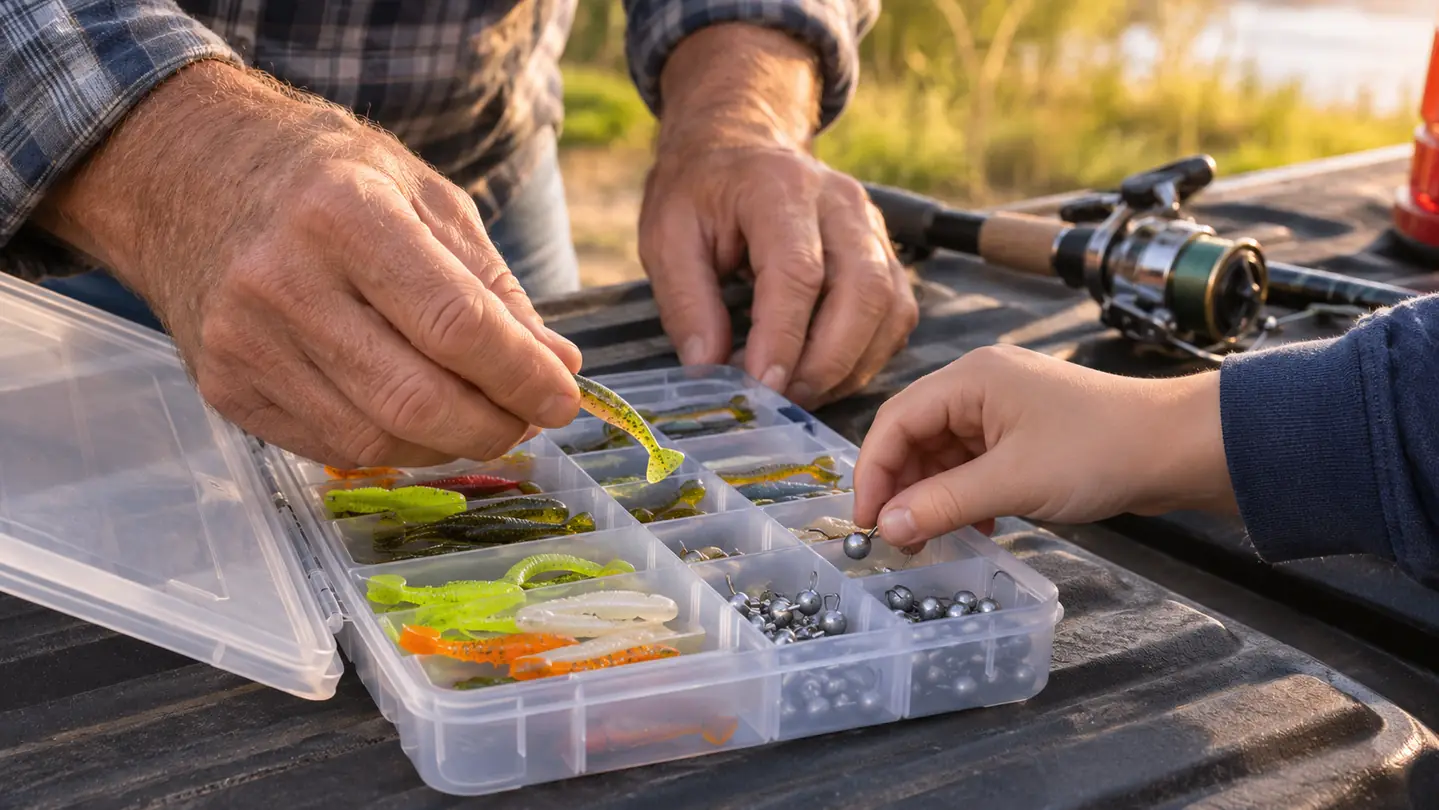
The kit wins on the thing that actually breaks a family trip, which is a mismatch. When you buy loose, the head and the body are two separate decisions made on two different days. You get home with a head whose collar is a hair too fat for the bodies in the bag, or a body that slides down the hook on the cast. Nobody warns you at the peg, because on the peg it all looks like it will work. The kit takes that decision away. The Double Cross jig heads in the box are made to go with the bodies in the box, and they do. Callie is 11 and she rigs her own now, off the pier rail, without turning around to ask me anything. That is worth more to me than saving a little on pieces.
The second thing is the split tail. The body has very little action of its own, and the tail is built to stay open in the water, which is the whole reason the thing works on a slow vertical presentation off a pier. Loose plastics are all different. Some are curly tails, some are tubes, some are skirts, and each one wants its own speed and its own head. When you are fishing with kids you do not have time to work out three presentations. You want one that works and a backup that works the same way. The kit gives you that in one tray, plus the E-Z Crappie Floats, so a kid who would rather watch a bobber than feel a jig has what she needs without me digging through a second box.
Organization is the quiet win. The whole kit lives in box 2 of our Plano, sorted by job, and it has stayed sorted since March. Loose jigs do not stay sorted. They end up at the bottom of the bag with the sinkers, and the heads find the one corner where the lid does not quite seal. I have pulled a jig head out of the cupholder of the Tahoe more than once.
The floats deserve their own mention because I did not expect to use them. Ben is 9 and he would rather watch something than feel something, and the floats in the box meant I did not have to rig a second rod with different tackle for him. Same kit, same tray, one float clipped on, and he is fishing while his sister jigs. That is the sort of thing you cannot tell from a listing photo, and it is the reason the tray has earned a compartment in the Plano instead of getting dumped into a zip bag the way the loose jigs used to.
Where Loose Jig Heads and Plastics Win
Loose is cheaper and I am not going to pretend otherwise. When you buy a kit you pay for 115 pieces, and there are bodies in that box I have not tied on and probably will not. If you know your water, if you know you want one profile and one weight, buying a handful of exactly that is the smarter money. You are not paying for the tray, or the floats, or the pieces that are going to sit in the compartment until the plastic gets stiff.
Loose also lets you chase the day. Wind on the reservoir, a little stain in the water after rain, fish sitting deeper than they were last week, all of that changes what you want on the end of the line. With loose jigs you can walk in and buy the weight and the profile the water is asking for that morning. With a kit you fish what is in the tray. That is not a knock on the kit. It is just what a fixed lineup is, and an angler who is out there twice a week will feel the difference more than I do.
What I miss about loose is the experiment. When you are buying one or two pieces at a time you can try something strange without committing to a tray full of it. I bought a pack of bodies once that turned out to be wrong for the pier in every way I could name, and it cost me almost nothing to learn that. In a kit, the lineup is the lineup. That is a gift when a kid is holding the rod and a limitation when you are the one doing the figuring.
And it takes less room. A handful of loose jigs in a sandwich bag fits in a pocket. The 115 piece kit takes a full compartment of a hard box that Wyatt is already carrying for all three kids, and on a hot evening I would rather he carry less. Loose wins that one outright.
Both catch fish. The difference is whether an 11-year-old can rig one without asking me for help.
The tray Callie rigs her own jigs out of
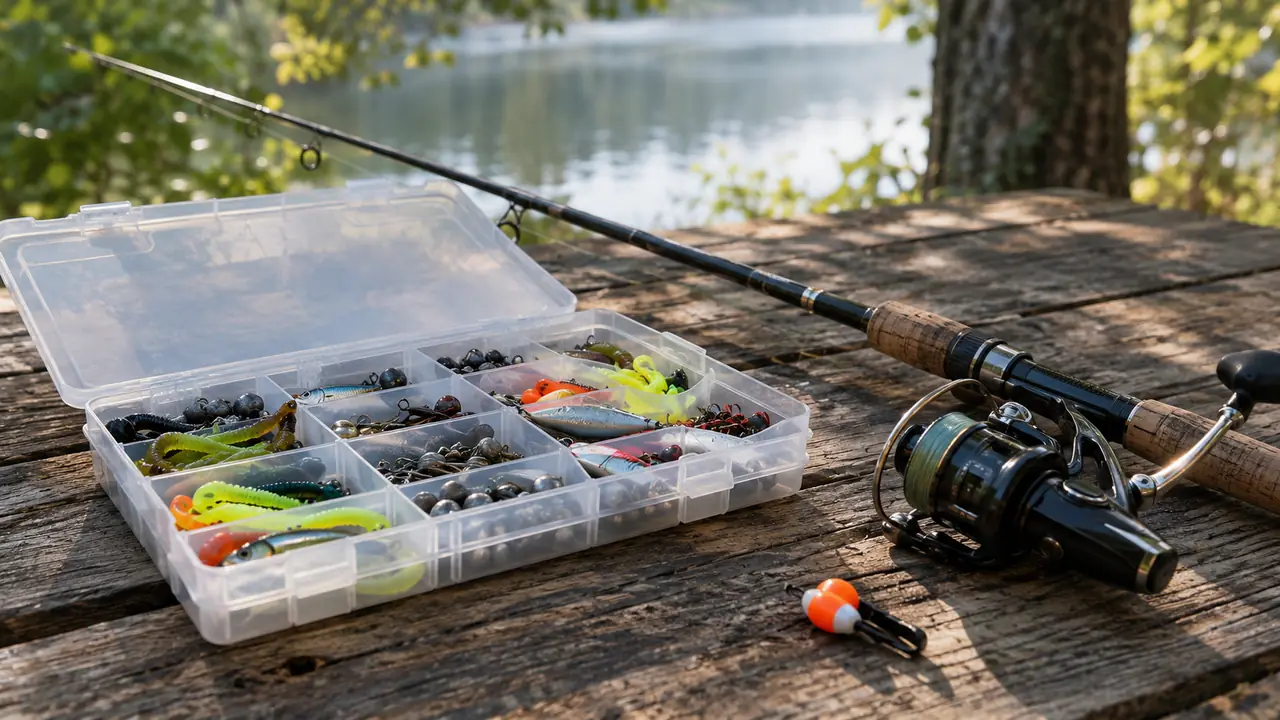
Bodies, Double Cross jig heads and E-Z Crappie Floats, sized to work together in one box. It has lived in box 2 of our Plano since March and nothing in it has failed yet.
Amazon Check Today's Price on Amazon →What Is Actually in the 115 Pieces
The kit is bodies, Double Cross jig heads and E-Z Crappie Floats, counted out to 115 pieces total. The hooks are high carbon steel with a spear point, and the heads are the jig type you would expect for crappie. The pieces are small. That is the point of them, and it is also my main gripe, so I will say both.
The first week I had it, I opened the box on the kitchen table and went through it just to see what I had, because I had never bought a kit before and I wanted to know whether 115 pieces meant 115 rigs. It does not. It means 115 individual pieces, and how many rigs that makes depends on how you fish. What surprised me was how few decisions were left on the table. In the loose days I would stand at the peg for ten minutes comparing two heads I could not really tell apart. With the tray open in front of me there was nothing to compare. I picked a body, I picked a head, and I went fishing.
Small pieces are hard for small fingers. Ben is 9 and he loses a body off the pier rail most trips, and jig heads turn up in the Tahoe for weeks afterward. We solved it by handing the rigging job to Callie, which she likes, and letting Ben run a bobber and a worm, which he likes better anyway. If you are buying this for a 9-year-old to handle entirely alone, expect to lose some pieces to the planks and the water.
Durability has been a non-event, which is the best thing I can say. Eight months in, with the tray riding in the back of the Tahoe and getting knocked around on the pier, nothing has broken, bent or been replaced. The bodies that we have used the most are the ones that get a little stiff by late summer, and that is true of any soft plastic I have left in a hot truck.
How a Weeknight at the Pier Actually Goes
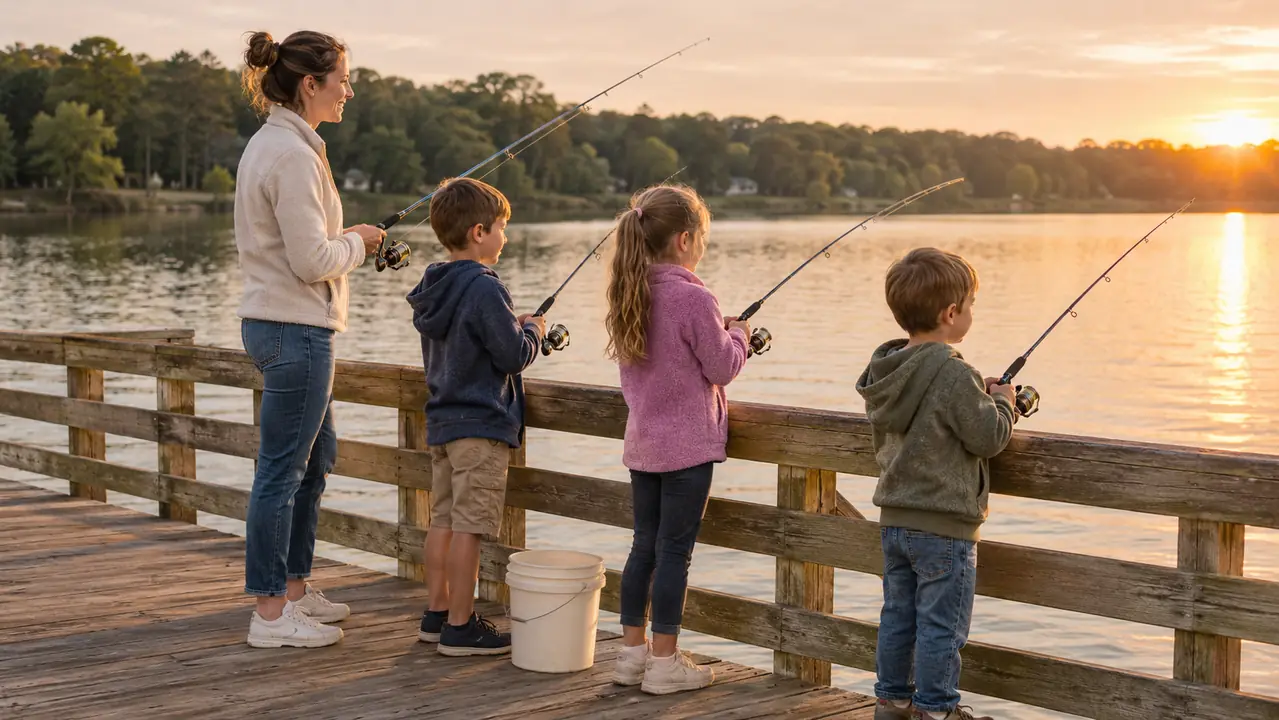
One weeknight in April we stayed until the light went. Callie rigged jigs, Wyatt tied the knots and carried the box, Ben fished a bobber and a worm off the end of the pier, and we came home with about a dozen crappie and kept them for supper. Nothing in the kit broke that night and nothing has broken since. I am not going to tell you the kit is why we caught them. We were there on a good evening and we stayed longer than we usually do, and staying longer is most of it.
Where the kit earns its place on a night like that is speed. Nobody stopped fishing to sort out tackle. The tray came out, Callie picked a body, the head matched, and she was back over the rail. Compare that to the spring before, when the bag came out and the heads and the bodies did not agree with each other and I burned ten minutes of good light fixing something that should have taken one.
One thing I got wrong early: I thought the kit would be the thing that got Ben fishing. It was not. What got Ben fishing was the bobber, and what got Callie fishing was being handed a job and being trusted with it. If you are buying this hoping a 9-year-old will suddenly take to working a jig, he probably will not, and that is not the kit's fault. Buy it because the pieces match, because the tray shuts, and because the kid who does like rigging can do it without you standing over her. The other one will find his own way in, on his own schedule.
Who Should Buy Which
Buy the Crappie Magnet kit if the jigs are for kids, if you are new to crappie, or if you want one purchase that covers a whole spring and lives in a box without turning into a mess. It is also the right buy if you fish off a pier at that slow vertical presentation and you want the tail doing the work while you hold still. The family case is the strongest one. One tray, matched parts, floats in the box, and a kid who can rig alone while you deal with the other two.
Buy loose jig heads and plastics if you already know your water, if you want to spend less, or if you want to pick the exact weight and profile on the morning of the trip. Loose also makes sense if you only fish a few times a year and do not want a tray of pieces drying out in the garage. Either way, check your state's rules on limits before you keep anything, and take a kid if you have one. That is the part I would not trade.
One kit, one tray, one less argument on the pier
115 pieces of bodies, Double Cross jig heads and E-Z Crappie Floats, made to go together. That is what got my 11-year-old rigging her own jig in March and kept her at it all spring.
Amazon Check Today's Price on Amazon →